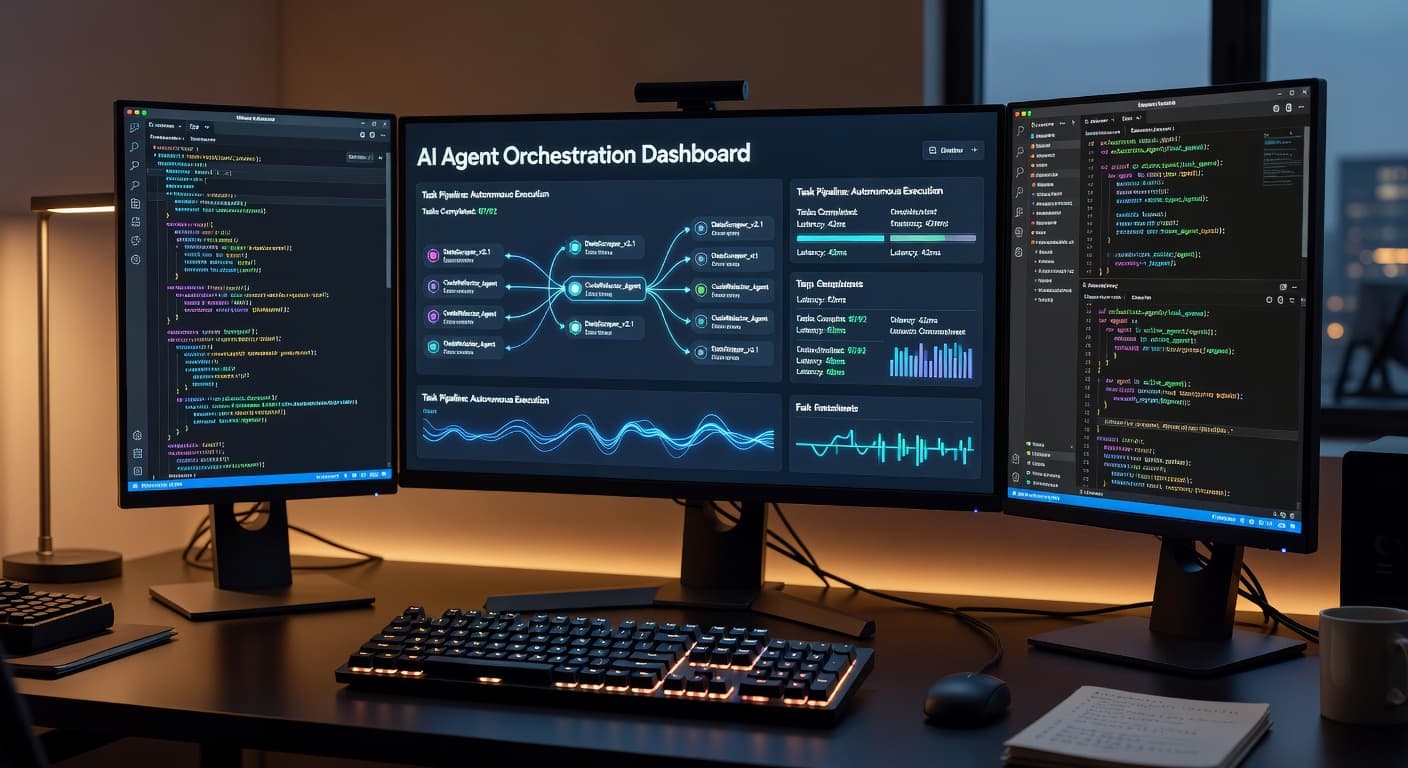
Agentic AI Transforms Software Development in 2026
Agentic AI Transforms Software Development in 2026
2026 is the year autonomous AI agents stop being a prototype and become infrastructure. The defining breakthrough in software engineering this year isn't a new language or framework—it's the rise of agentic AI systems that autonomously handle complex tasks across the entire software development lifecycle.
From ChatGPT to Agent Orchestration
We've moved beyond code completion assistants. Agentic AI systems now orchestrate multi-step workflows: generating code, writing tests, debugging failures, suggesting architectural improvements, and handling deployment. These aren't tools that suggest—they're systems that execute and iterate until objectives are met.
Industry analysis shows the transformation is already underway:
- 40% of enterprise applications will be integrated with task-specific AI agents by year-end, up from less than 5% at the start of the year
- 80% of large engineering teams are projected to evolve into AI-augmented units by 2030
- 30-35% productivity gains in software development lifecycle (SDLC) are materializing in early adopters
Intent-Driven Development
The paradigm shift is profound. Engineers no longer write step-by-step instructions—they express high-level intent. An engineer might tell an agentic system: "Build a REST API for user management with role-based access control, async task queue, and 99.9% SLA." The AI agents then:
- Generate code across multiple services
- Create test suites for each component
- Suggest architectural patterns
- Implement monitoring and alerting
- Propose optimization opportunities
The engineer supervises, reviews, and refines. The agents do the execution.
The Skills Shift
This creates a fundamental repositioning of engineering roles. Rather than writing boilerplate code, engineers become:
- Supervisors: Directing agent behavior and validating outputs
- Architects: Focusing on system design and strategy
- Governors: Ensuring compliance, security, and organizational alignment
The jobs aren't disappearing—they're being elevated. Fewer engineers can build more ambitious systems.
Enterprise Adoption: Finance and Healthcare Lead
Finance and healthcare are moving fastest, with initial wins in:
- AI-powered security scanning
- Rapid API generation from specifications
- Automated infrastructure provisioning
- Trust and compliance auditing
Full maturity—with better inter-agent coordination and safeguards—is 2-5 years out. But early movers are shipping faster, with fewer people.
The Competitive Advantage
Teams using agentic AI are shipping features 2-3x faster while maintaining or improving quality. The constraint shifts from "how do we find enough developers?" to "how do we supervise autonomous systems effectively?"
Smaller, nimble teams can now build enterprise-grade systems. The traditional hiring arms race has a reset button.
Challenges Ahead
Multi-agent systems introduce new complexity:
- Agent alignment: Ensuring agents optimize for the right goals
- Coordination: Managing dependencies between autonomous agents
- Explainability: Understanding why agents make certain decisions
- Failure modes: What happens when agents disagree or fail?
Organizations investing in governance frameworks and agent safety now will have a decisive advantage.
The Bottom Line
If you're a senior engineer in 2026, the question isn't "Will AI replace me?" It's "Am I equipped to lead teams of AI agents?" The engineers building the systems that lead engineering teams will be in extraordinary demand.
The software development world is symphonic now: AI conducts, humans compose. And the music is getting ambitious.
Source: Deloitte Technology Outlook 2026
Comments
Loading comments...