April Skywatching Guide: The Easter Comet and the Lyrid Meteor Shower
April Skywatching Guide: The Easter Comet and the Lyrid Meteor Shower
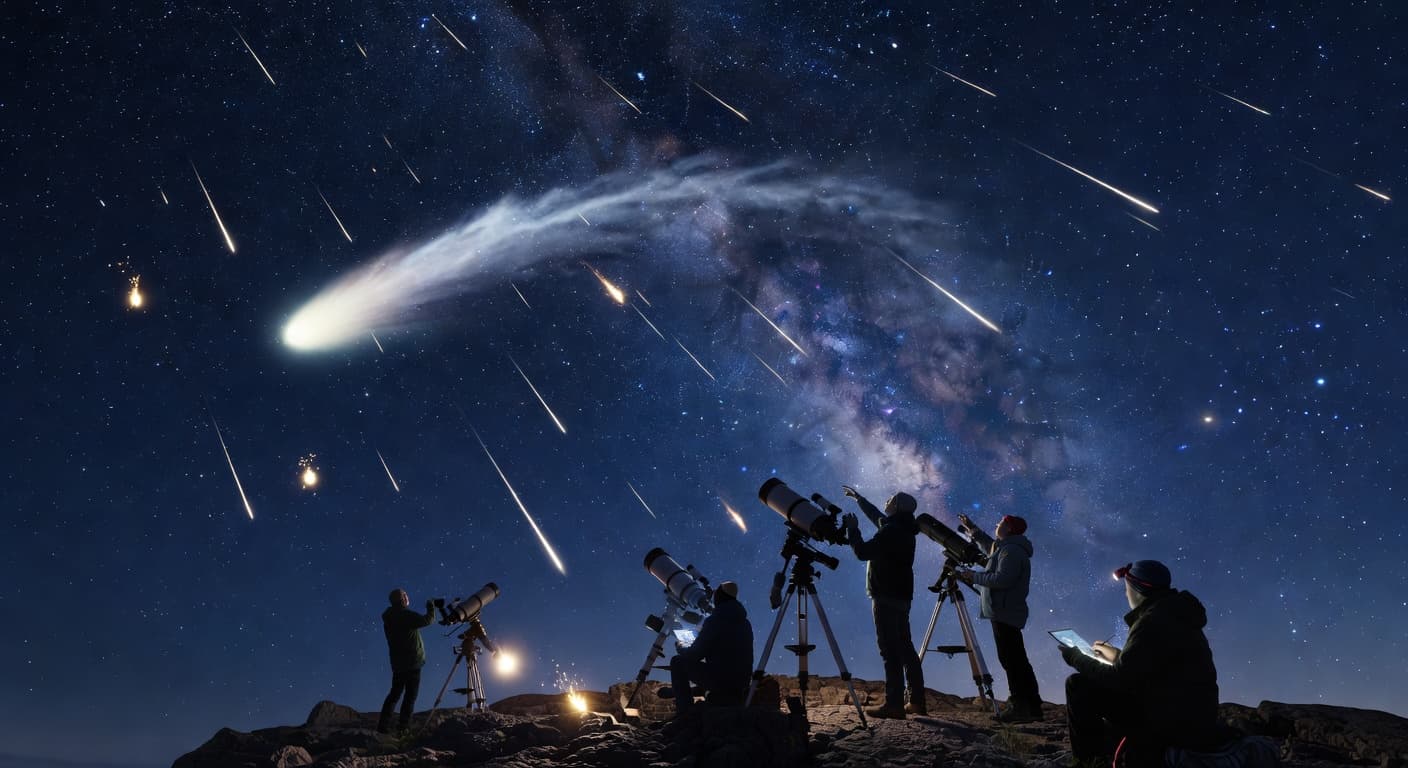
April 2026 is shaping up to be a remarkable month for skywatchers. Between a newly discovered comet making a dangerous dash toward the Sun and one of the year's reliable meteor showers, there's plenty to observe—if you know where to look.
Comet MAPS: A Sungrazer's Close Call
Comet C/2026 A1 (MAPS) was discovered on January 13 by four French astronomers at the AMACS1 observatory in Chile. Since then, it's brightened roughly 600-fold to magnitude 11—visible in 8-10 inch amateur telescopes.
What makes this comet particularly exciting is its classification: it's a Kreutz sungrazer. Some of the brightest comets in history belonged to this family. The Great Comets of 1843 and 1882, and Comet Ikeya-Seki (1965) all captured the imagination of observers worldwide. More recently, Comet Lovejoy lit up December 2011.
The Critical Test: April 4
Comet MAPS will reach perihelion (closest approach to the Sun) on April 4 around 10 a.m. EDT. At that moment, it will pass just 99,000 miles from the solar photosphere—well within the Sun's scorching corona where temperatures reach 2 million degrees Fahrenheit.
Survival is uncertain. The comet could be completely vaporized or torn apart by the Sun's massive gravitational forces. But if it makes it through, it might briefly become visible in the western twilight sky between April 8-14—potentially as bright as Venus.
According to comet expert Seiichi Yoshida, MAPS could peak near magnitude -5 at perihelion. That would make it one of the brightest objects in the evening sky.
Viewing Safety
Here's the critical bit: do not attempt to observe the comet near the Sun directly. Looking at the Sun, even briefly, can cause permanent blindness.
The safest approach? Watch it on your screen via NASA's Solar and Heliospheric Observatory (SOHO). The LASCO C3 camera will track the comet from April 2-6, and near-live images are freely available online.
The Lyrid Meteor Shower
More reliably, the Lyrid meteor shower peaks April 22-23. Expect 10-20 meteors per hour from the constellation Lyra, best viewed after midnight in dark skies away from light pollution.
Mercury at Greatest Elongation
On April 3-4, Mercury reaches its greatest western elongation—the best viewing opportunity all year. Look low in the western sky just after sunset. Binoculars help significantly.
What You'll Need
- For comets: 8-10 inch telescope or binoculars, clear western horizon, patience
- For meteors: Dark skies, a reclining chair or blanket, patience (and warm clothing—April nights are cool even in the UK)
- For Mercury: Binoculars and a clear horizon
April offers something for every observer, from casual naked-eye watchers to serious amateurs with telescopes.
Source: Space.com - Newly discovered comet could be visible in daytime skies this April
Comments
Loading comments...