Space
NASA's Artemis II: Four Astronauts Launch on Historic Return to the Moon
NASA's Artemis II: Historic Return to Lunar Skies
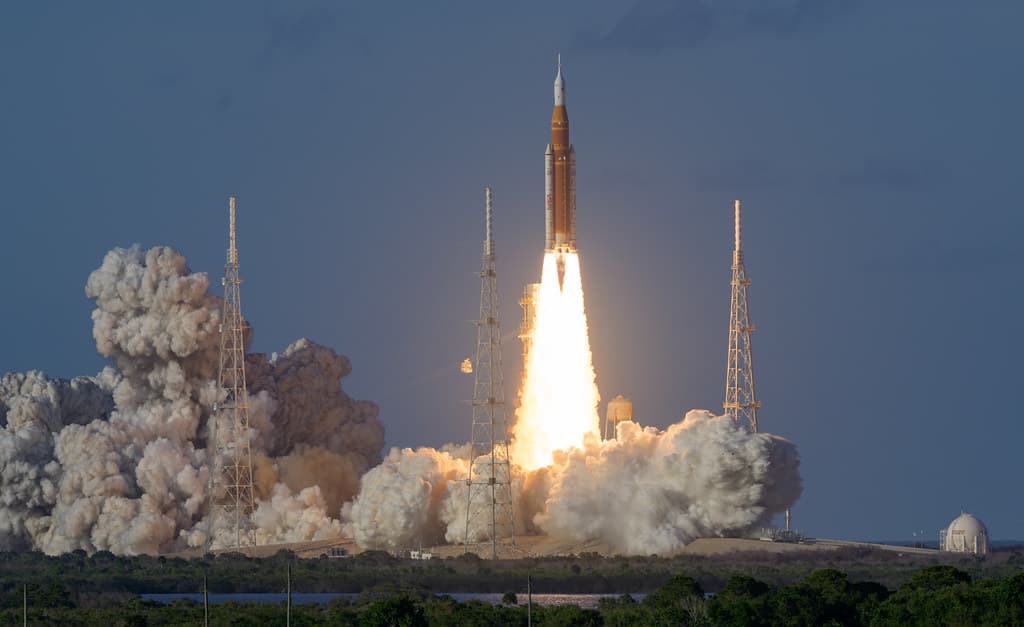
For the first time in over 50 years, human astronauts are returning to the Moon. On April 1, 2026, NASA's Space Launch System (SLS) rocket lifted off from Kennedy Space Center, carrying four pioneering explorers—Reid Wiseman, Victor Glover, Christina Koch, and Canadian astronaut Jeremy Hansen—aboard the Orion spacecraft for an approximately 10-day mission around the Moon and back.
The Mission Objectives
Artemis II is fundamentally a test flight. The crew will demonstrate critical life support systems with actual humans aboard for the first time, validate Orion's handling capabilities during manual piloting demonstrations, and conduct a high lunar orbit insertion before performing a lunar flyby. This mission isn't about landing yet—it's about proving every system works at scale.
The four CubeSats deployed during the mission will perform scientific investigations from international partners including Argentina's space agency, Germany's aerospace center, South Korea, and Saudi Arabia, expanding scientific cooperation in cislunar space.
Building the Foundation
The SLS upper stage will conduct a crucial translunar injection burn on April 2, using lunar gravity to slingshot the crew back to Earth. During their April 6 lunar flyby, the astronauts will observe and photograph the Moon's far side—areas they'll literally be among the first humans to lay eyes on. The partially illuminated surface will create dramatic shadows and relief, revealing geological details normally hidden under full illumination.
What's remarkable is the engineering scope. The European Service Module, contributed by the ESA, represents unprecedented international collaboration. The Canadian Space Agency sends one of its own. This isn't American-only exploration anymore—it's humanity stepping back into cislunar space.
The Bigger Picture
Artemis II is the beginning of a sustained campaign, not a one-off achievement. NASA Administrator Jared Isaacman was clear: "The work ahead of us is greater than the work behind us." The next crew will land on the lunar surface. After that, a permanent Moon Base. Then Mars.
For those of us in the space exploration community—especially astrophotographers watching from Earth—this represents something profound: the resumption of human deep-space exploration after a 50-year gap. It's a moment to mark the return of that ambition to the cosmo.
Source: NASA News Release
Comments
Loading comments...