Space
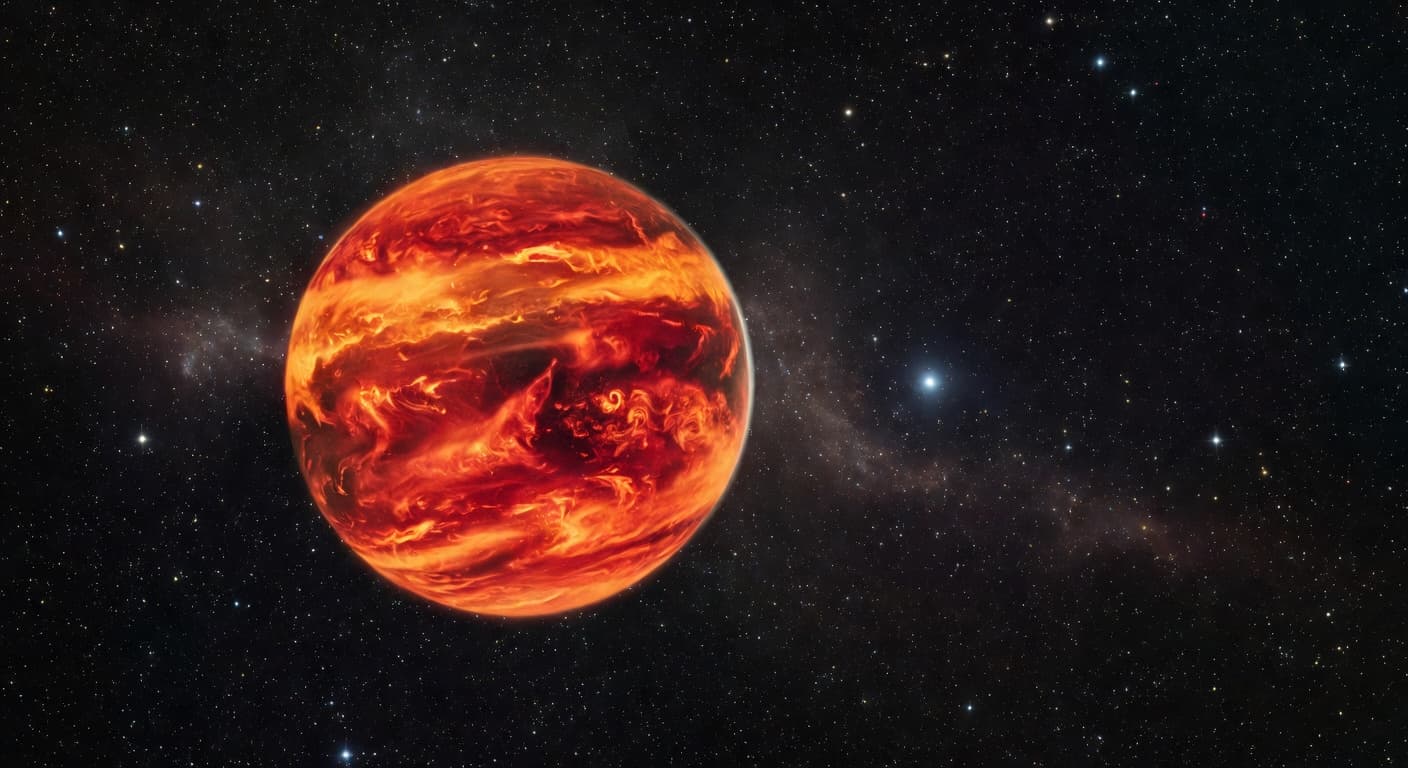
JWST Directly Images 29 Cygni b: Redefining What Makes a Planet
JWST Directly Images 29 Cygni b: Redefining What Makes a Planet
For decades, astronomers have grappled with a thorny question at the edge of planetary science: where does a planet end and a failed star begin? The James Webb Space Telescope just provided a striking answer, and it's forcing a rethink of how we classify massive worlds.
On April 14, 2026, researchers announced the first direct image of 29 Cygni b, a celestial object orbiting a nearby star with a mass roughly 15 times Jupiter's. Despite sitting in the "brown dwarf zone," JWST's infrared spectroscopy reveals compelling evidence that 29 Cygni b is a planet—one that formed through bottom-up accretion in a protoplanetary disk, not through top-down collapse like a star.
The Classification Crisis
The boundary between planet and brown dwarf (a sub-stellar object too massive to be a planet, too cool to fuse hydrogen) has always been fuzzy. Mass alone isn't enough: some massive planets form like planets (through accretion), while some objects below the brown dwarf threshold might form like stars (through disk fragmentation).
29 Cygni b sits exactly on this line. At 15 Jupiter masses, it occupies the theoretical sweet spot where both mechanisms are plausible:
- Via accretion (planetary formation): Small dust grains collide and grow over millions of years into larger bodies, eventually accreting gas.
- Via fragmentation (stellar formation): A region of a protoplanetary disk becomes gravitationally unstable and collapses directly into a massive object.
The JWST Evidence
William Balmer and his team at Johns Hopkins University used Webb's coronagraphic imaging to peer past the glare of 29 Cygni b's parent star. They looked for spectral signatures of heavy elements—carbon, oxygen, and other metals—that would indicate planetary accretion.
The results were definitive: 29 Cygni b is enriched in metals, containing about 150 Earth masses of heavy elements. This abundance is exactly what you'd expect from an object that swept up metal-rich dust and planetesimals during formation. The team also confirmed that the planet's orbit aligns with its star's spin axis—another hallmark of planetary systems like our own.
Why This Matters
This observation does more than classify one distant world. It:
- Validates formation models: Shows that massive planets can form through accretion, even at extreme distances.
- Broadens the habitable zone: If super-Jupiter worlds form in diverse environments, it increases the odds of finding Earth-sized planets around other stars.
- Challenges assumptions: The old mass-based divide between planet and brown dwarf may need revision. Formation mechanism, not mass alone, may be the key distinction.
29 Cygni b orbits at roughly the distance of Uranus in our solar system (1.5 billion miles) and is still young enough to glow with residual heat from formation. It's one of four targets in Balmer's program designed to probe this critical boundary—expect more insights as JWST continues its survey.
The Bigger Picture
JWST has already transformed exoplanet science, discovering everything from "rotten egg" planets with hydrogen sulfide atmospheres to the most distant galaxies in the universe. But this image is special: it forces us to ask not just "what is out there?" but "what do we mean when we say 'planet'?"
For astrophotography enthusiasts, 29 Cygni b is a reminder of how much has changed since the first exoplanet discovery in 1995. We've gone from statistical inference to direct imaging in three decades. The universe is larger and stranger than we thought.
Comments
Loading comments...