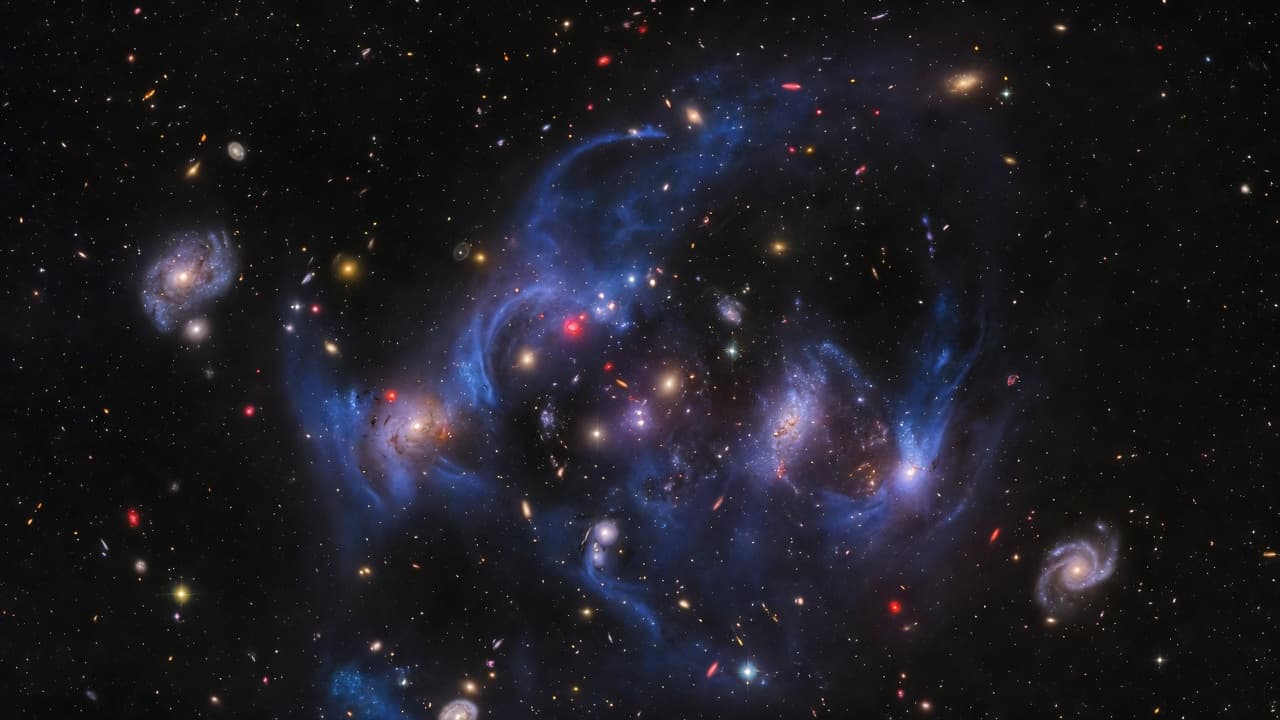
JWST Discovers 'Black Hole Stars' — Early Universe Contains Mysterious Objects
JWST Discovers 'Black Hole Stars' — Rewriting Early Universe Models
Since 2022, the James Webb Space Telescope has discovered bright "little red dots" in the early universe that shouldn't exist. New spectroscopic data provides the strongest evidence yet: these are "black hole stars"—a new class of cosmic objects that challenges our understanding of galaxy formation.
The Mystery
JWST's initial images revealed unexpectedly bright red objects in the early universe. Too bright, too compact for standard models. Astronomers called them "little red dots" but couldn't explain them.
New spectroscopic observations from JWST's NIRSpec instrument analyzed over 40 spectral features. The signature matches theoretical predictions for black hole stars: objects where a supermassive black hole dominates, creating extreme conditions.
What This Means
If black hole stars existed 300-500 million years after the Big Bang, current formation models are wrong. Supermassive black holes shouldn't be that massive, that fast.
Possible explanations:
- Direct collapse of massive gas clouds into black holes
- Exponentially rapid black hole growth
- Exotic primordial physics in the earliest moments
Each reshapes our cosmology.
The Road Ahead
JWST continues observing these objects. Building a complete census will determine if they're common or rare, and whether our understanding of the universe's earliest epoch is fundamentally correct.
This is why JWST cost $10 billion and took 25 years. The universe is stranger than we thought.
Source: NASA JWST Release
Comments
Loading comments...