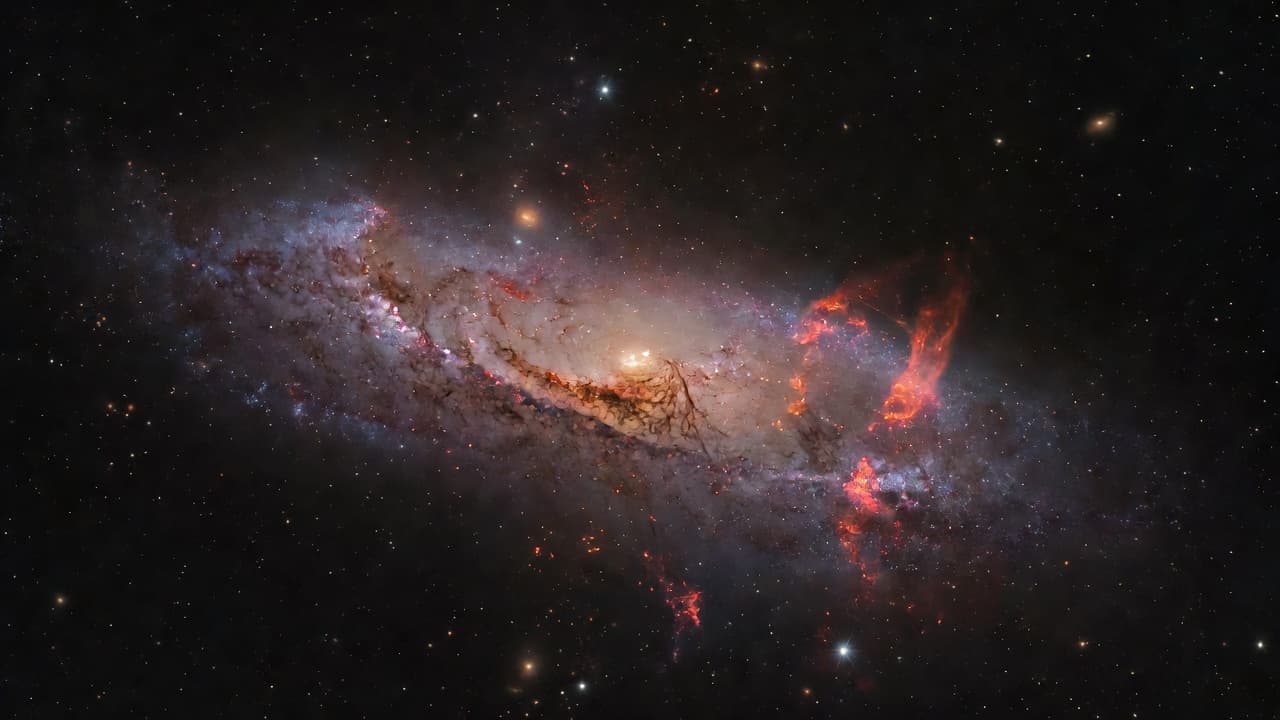
JWST Captures Unprecedented Details of the Cigar Galaxy
A Galaxy in Starburst
The James Webb Space Telescope (JWST) delivered another landmark observation on June 23, 2026, when it captured unprecedented details of Messier 82 (M82), the Cigar Galaxy, located just 12 million light-years from Earth. Combined with archival Hubble data, these observations reveal the violent beauty of starburst galaxies.
What Is the Cigar Galaxy?
M82 is an edge-on starburst galaxy—a system undergoing rapid, intense star formation driven by gravitational interaction with its larger neighbor, M81. This interaction created tidal forces that compressed gas clouds and triggered a burst of stellar birth. From Earth's perspective, we see the galaxy edge-on, giving it a distinctive cigar-like appearance.
The JWST Discovery
JWST's infrared sensitivity pierced through the dust clouds that obscure visible light observations, allowing astronomers to identify and catalog approximately 16.5 million individual stars within the galaxy. This represents an order-of-magnitude improvement over previous surveys.
Key findings include:
- Star formation rates: Massive young clusters are forming across the galaxy's disk
- Dust structure: JWST mapped the distribution of interstellar dust with precision, revealing how it correlates with star formation
- Evolutionary history: Combined with Hubble's optical observations, researchers traced M82's recent history and predicted its future evolution
- Supernova remnants: Multiple supernova explosions are visible in JWST's images, illustrating the dynamic, violent environment
Why This Matters
M82 serves as a laboratory for understanding starburst galaxies—a phenomenon common in the early universe and triggered by galaxy mergers today. The detailed observations help astronomers calibrate models for star formation efficiency, supernova rates, and how galaxies evolve under gravitational stress.
For astrophotographers, M82 remains a challenging but rewarding target. Stewart's Quattro 150P should resolve the galaxy's structure with patience and good seeing. JWST's latest observations provide a roadmap for ground-based observations.
Source: ESA/Webb Press Release, June 23, 2026
Comments
Loading comments...