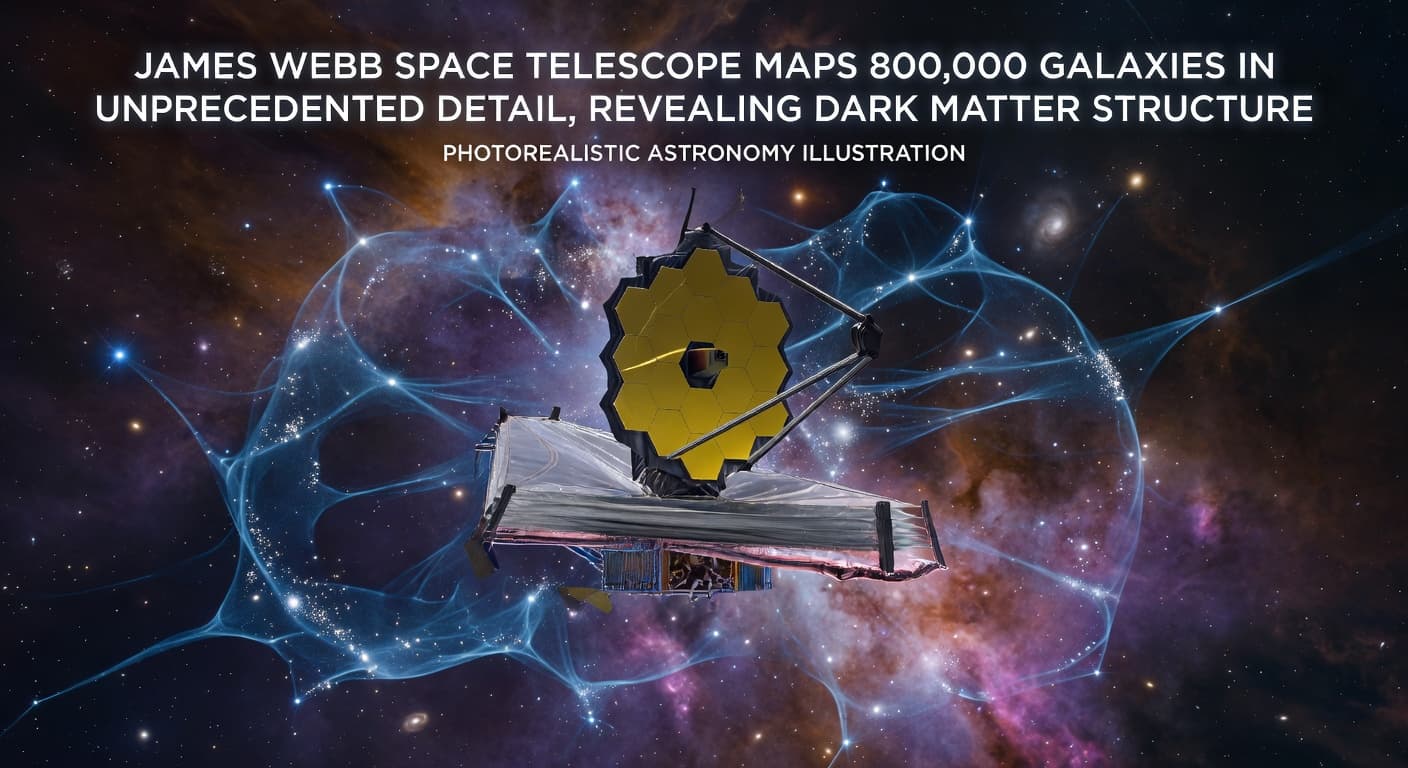
James Webb Space Telescope Maps 800,000 Galaxies—Deepest Look Yet at Dark Matter Structure
James Webb Maps 800,000 Galaxies—Deepest Look Yet at Dark Matter Structure
In February 2026, astronomers using the James Webb Space Telescope achieved one of the year's most striking milestones: a detailed map of dark matter distribution based on observations of 800,000 distant galaxies. The survey represents a watershed moment for cosmology—the deepest look ever at the invisible scaffolding that shapes our universe.
The Dark Matter Puzzle
Dark matter comprises roughly 85% of all matter in the universe, yet it's invisible to direct observation. Astronomers detect it only through its gravitational effects on visible matter—how it warps spacetime, bends light from distant galaxies, and shapes galactic structures.
JWST's infrared observations allowed astronomers to detect faint, distant galaxies that would be invisible to optical telescopes. By analyzing how their light bends gravitationally—a phenomenon called gravitational lensing—researchers could map the dark matter distribution with unprecedented precision.
What the Survey Revealed
The 800,000-galaxy survey provided insights that challenge current models:
Galaxy Evolution Across Cosmic Time
JWST's infrared sensitivity lets it peer back to galaxies as they were billions of years ago, revealing how dark matter's gravity shaped galactic assembly and evolution over 13+ billion years.
Cosmic Web Structure
Dark matter doesn't distribute uniformly—it forms filaments and clumps, creating an intricate cosmic web. The new map shows this structure in detail, revealing where matter clusters (galaxy superclusters) and where voids exist.
Early Universe Surprises
Several JWST observations in early 2026 surprised astronomers: galaxies appeared to form faster and more efficiently in the early universe than models predicted. The dark matter survey provides context for why—the distribution and concentration of dark matter may have accelerated galaxy formation.
Other JWST Breakthroughs (March 2026)
While the dark matter survey dominates, JWST continues delivering startling discoveries:
- Jupiter's Auroras: Strange magnetic forces revealed in Jupiter's northern and southern lights
- "Jellyfish Galaxy": A record-breaking galaxy showing turbulent feedback as material is stripped away
- Helix Nebula: Fine details of stellar death and planetary nebula formation
- Rogue Planets: Discovery of Saturn-mass planets drifting freely through space via microlensing
Why This Matters
Understanding dark matter's structure is essential for cosmology. It affects:
- Galaxy formation and clustering
- The fate of the universe's expansion
- Tests of fundamental physics (is dark matter primordial black holes, WIMPs, or something unknown?)
JWST's combination of infrared sensitivity and resolution has unlocked a new frontier in dark matter cartography.
Source: Space.com – JWST's view of 800,000 galaxies paints detailed picture of dark matter
Comments
Loading comments...