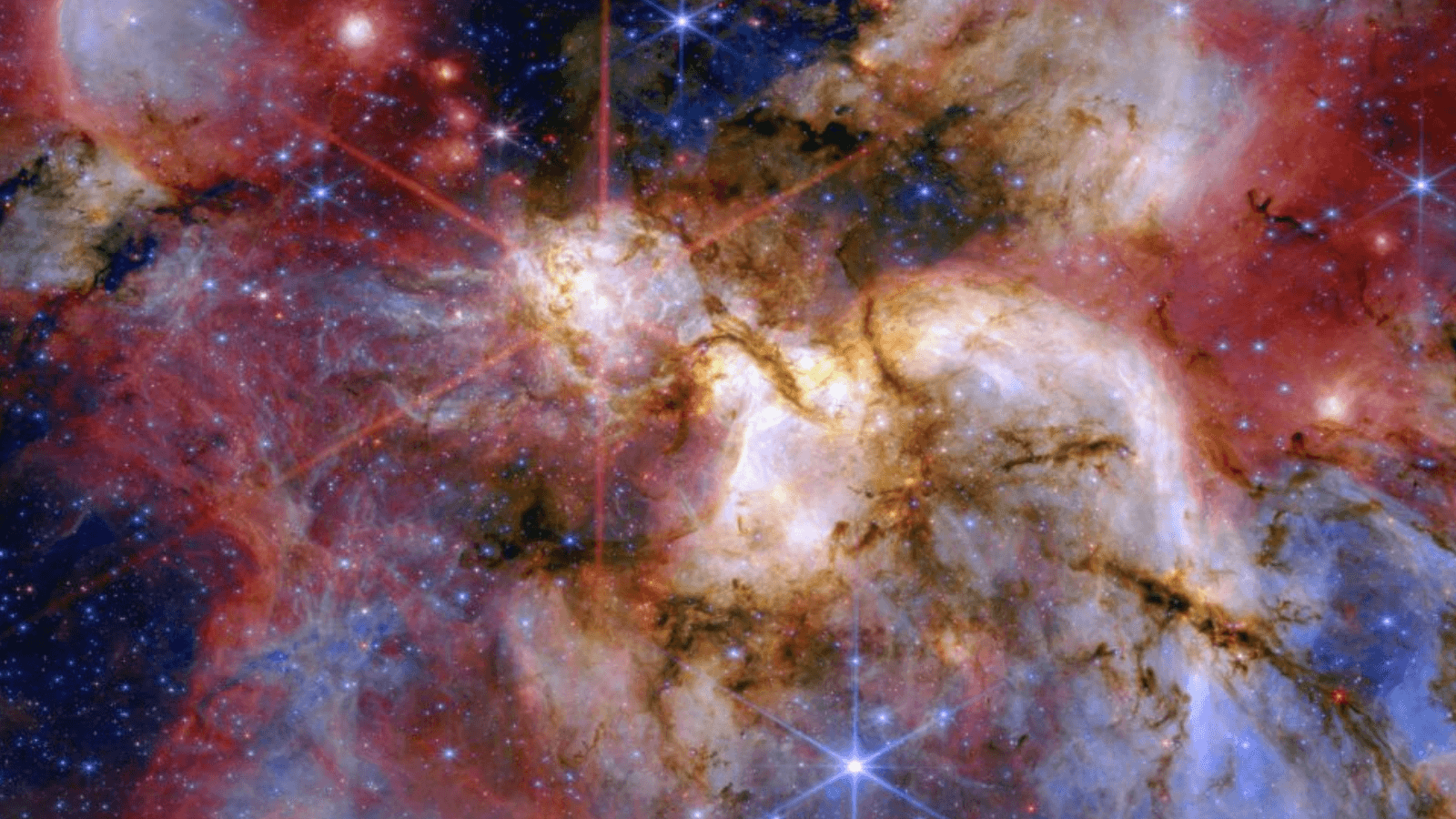
JWST Pierces the Dust: New Images Reveal Star Birth in W51
The James Webb Space Telescope just peered through the dust of the W51 star-forming region and revealed structures we've never seen before. These April 2026 images show protostars, shockwaves, and the messy violence of stellar birth—all hidden from previous telescopes.
What Makes This Special
W51 is one of the most active star-forming regions in our galaxy, roughly 17,000 light-years away. The problem? Dust obscures everything. Optical telescopes see darkness. Infrared? JWST sees through it like it's not even there.
The new images reveal:
- Protostars deep inside molecular clouds, still gathering material, not yet hot enough to ignite fusion
- Shockwaves propagating through the gas—the impact of stellar winds and jets from newborn stars
- Complex structures in the dust lanes that trace the architecture of star formation in real time
It's like watching a construction site in time-lapse, except the cranes are gravity and the blueprints are written in hydrogen.
Why This Matters for Astronomy
W51 is a laboratory for understanding how stars form at scale. Most star formation theory comes from observations of nearby, relatively quiet regions. W51 is chaotic, dense, and active. Studying it with JWST's infrared sensitivity lets us understand the physics in the densest, most violent environments where stars are born.
Every image JWST releases pushes our understanding of stellar birth, and W51 shows why: we're finally seeing the process as it actually happens, dust and all.
Comments
Loading comments...