Space
A Planet That Shouldn't Exist: JWST Reveals How WD 1856 b Survived Its Star's Death
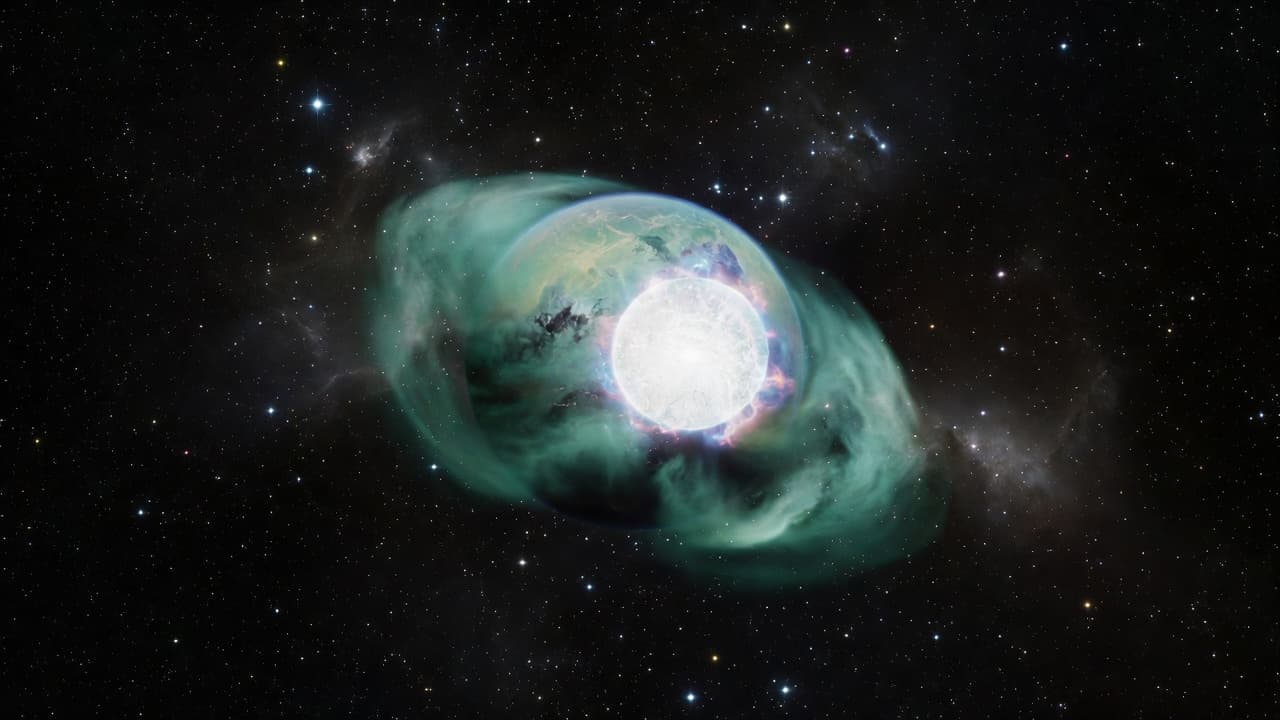
Astronomers have long considered planets orbiting white dwarfs theoretical curiosities at best. The violent evolution of a star into a white dwarf should destroy or eject any close-in worlds. Yet WD 1856 b, a Jupiter-sized planet orbiting a white dwarf 80 light-years away, has now been studied in unprecedented detail by the James Webb Space Telescope.
Discovered in 2020 via transit photometry, the planet completes an orbit every 1.4 days at a distance of just 0.02 AU from its host. This proximity should have been impossible after the star's red giant phase expanded to engulf the inner solar system. How did it survive?
JWST's transmission spectroscopy revealed a surprisingly clear atmosphere dominated by hydrogen and helium, with trace amounts of water vapor and carbon dioxide. The data suggest the planet avoided destruction by migrating outward during the star's expansion and then spiraling inward again after the white dwarf formed—likely through gravitational interactions with other bodies in the system.
The most striking discovery was the planet's temperature: roughly 260°F (126°C), significantly hotter than radiation from the white dwarf alone would produce. This excess heat is residual energy from tidal heating when the planet migrated inward, occurring between 3 and 5.5 billion years after the white dwarf formed.
These findings carry direct implications for our own solar system. In roughly five billion years, the Sun will become a white dwarf. Understanding how WD 1856 b survived provides a roadmap for the possible fates of Jupiter, Saturn, and the outer solar system.
The research team continues observations of WD 1856 b, with four additional transits measured to examine atmospheric chemistry in greater detail. Each observation peels back another layer of this cosmic anomaly—a planet that defied the odds and continues to challenge our models of planetary survival.
Source: NASA Science - Webb Studies Planet Survival Around White Dwarf
Comments
Loading comments...