NASA's Nancy Grace Roman Space Telescope Construction Complete—Fall 2026 Launch in Sight
NASA's Nancy Grace Roman Space Telescope Construction Complete
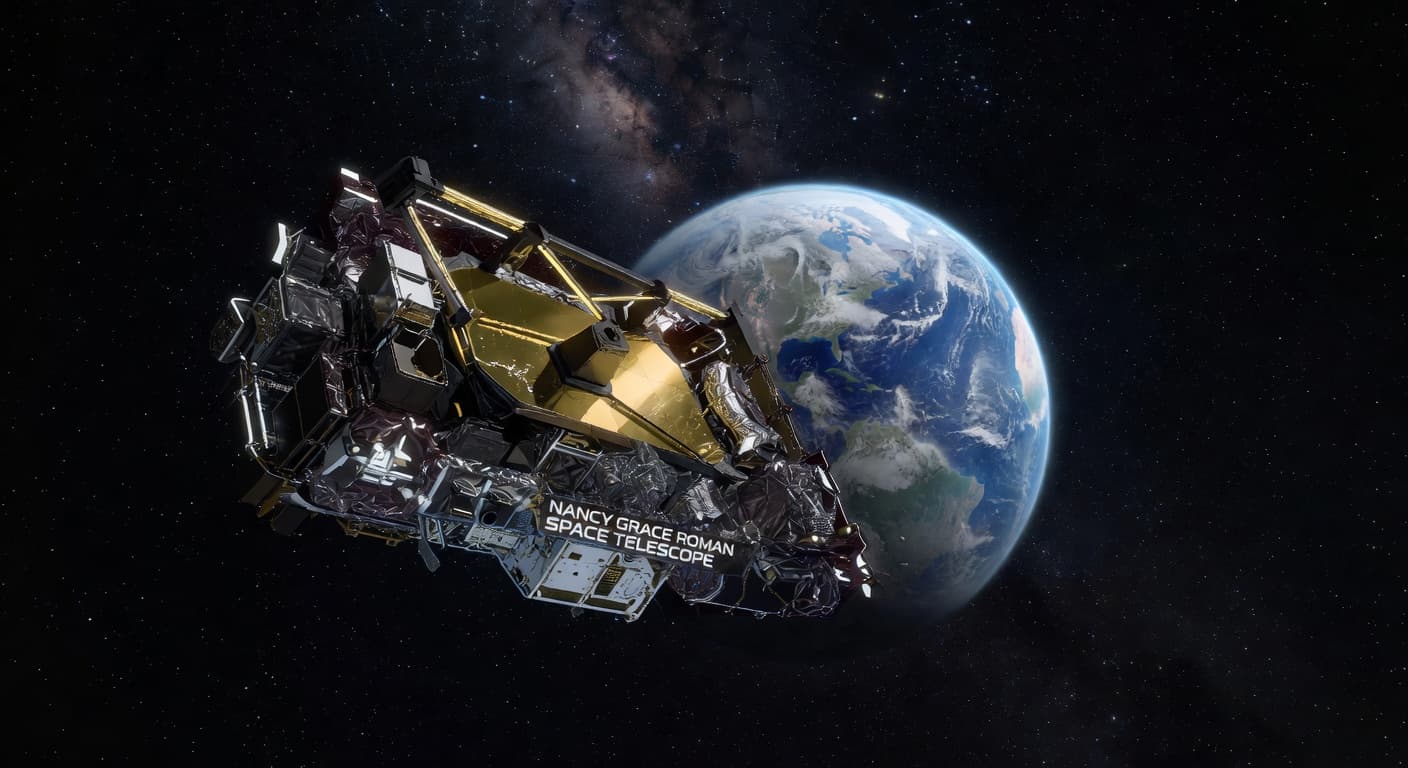
On November 25, 2025, technicians at NASA's Goddard Space Flight Center in Greenbelt, Maryland achieved a defining milestone: the assembly of the Nancy Grace Roman Space Telescope was complete. After months of meticulous engineering and testing, the inner and outer portions of the observatory were successfully integrated—a moment NASA says brings the mission to its final critical phase.
What Roman Will Accomplish
The Roman Space Telescope is designed to be one of the most transformative observatories ever built. From its vantage point a million miles from Earth (at the L2 Lagrange point), Roman will:
- Hunt for distant exoplanets: Expected to discover over 100,000 worlds, including potentially habitable planets in the zones where life could exist
- Map dark matter and dark energy: Using unprecedented deep-space surveys to probe the universe's expansion and invisible matter
- Image planets around other stars: The coronagraph instrument will directly photograph Jupiter-sized worlds, dusty disks, and stellar systems
- Survey billions of galaxies: With a 288-megapixel camera gathering data 20 times faster than Hubble
Timeline and Launch
Roman will now move to NASA's Kennedy Space Center in Florida for launch preparations beginning in summer 2026. The mission is officially targeted for May 2027, but NASA engineers say they're on track for a potential launch as early as fall 2026—making this critical path watch for Stewart and any stargazers tracking major space missions.
The observatory will launch aboard a SpaceX Falcon Heavy rocket, the same vehicle carrying it to its L2 destination.
The Engineering Behind It
Roman carries two primary instruments:
- Wide Field Instrument (WFI): A 288-megapixel infrared camera for broad cosmic surveys
- Coronagraph Instrument: A technology demonstrator for directly imaging exoplanets by blocking starlight glare
The mission's first five years include three core scientific surveys covering 75% of the primary mission:
- High-Latitude Wide-Area Survey (dark matter and galaxy evolution)
- High-Latitude Time-Domain Survey (dynamic cosmic phenomena)
- Galactic Bulge Time-Domain Survey (searching for habitable-zone exoplanets via microlensing)
Why This Matters
As NASA's Associate Administrator Nicky Fox noted: "Within our lifetimes, a great mystery has arisen about the cosmos: why the expansion of the universe seems to be accelerating. There is something fundamental about space and time we don't yet understand, and Roman was built to discover what it is."
Roman represents a paradigm shift—not just in what we observe, but in how fast we gather data. The mission will return 20 petabytes (20,000 terabytes) over five years, more data than Hubble has collected in 30+ years.
Comments
Loading comments...