Space
NASA's Psyche Probe Captures Stunning Mars Image Before Historic Flyby
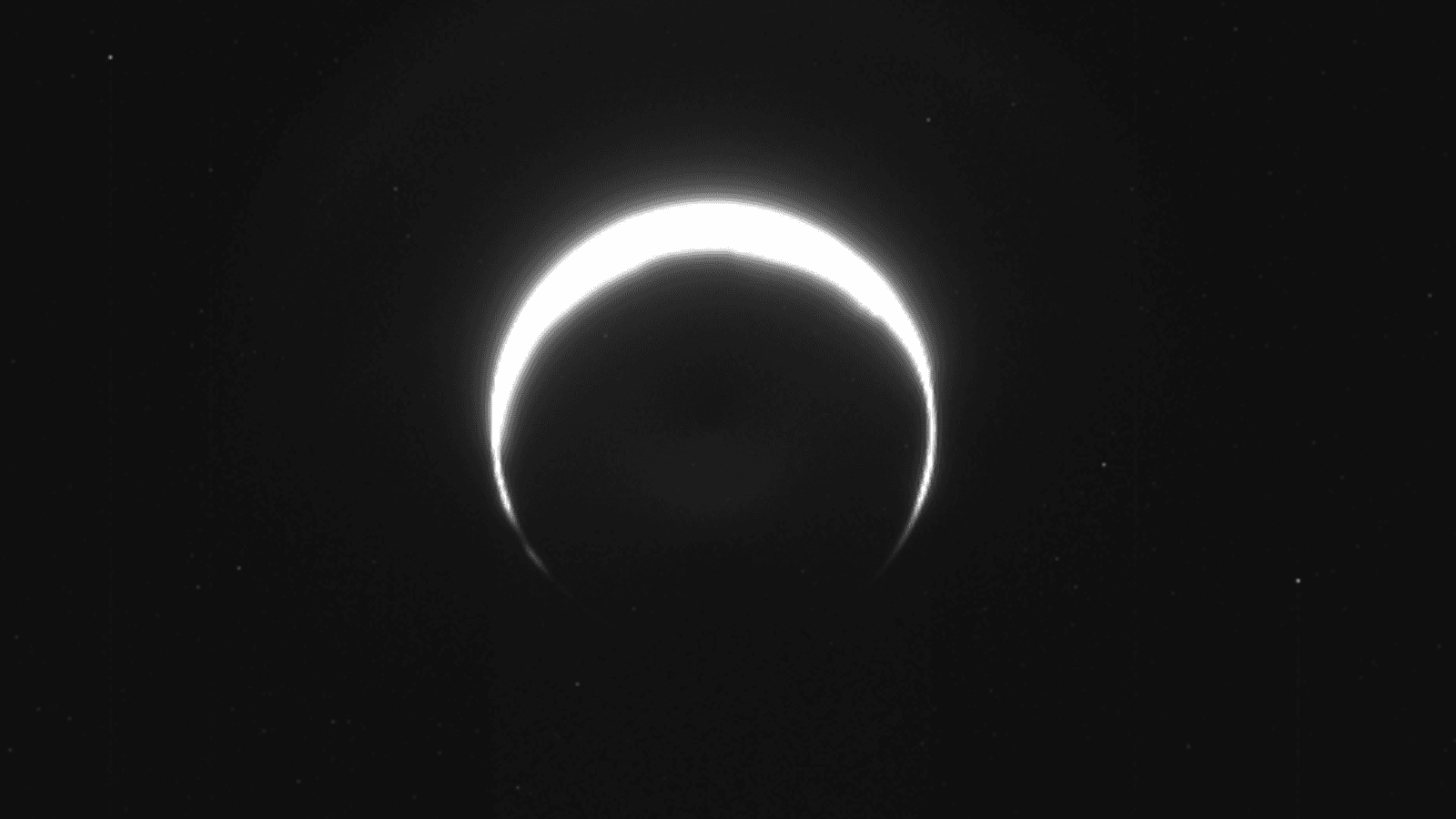
NASA's Psyche spacecraft has captured a breathtaking image of Mars that bears a striking resemblance to a solar eclipse—but it's actually something far more valuable from a scientific perspective. The probe's image arrives just days before a planned gravitational assist flyby on May 15th.
Not an Eclipse—But Equally Stunning
The image, taken during Psyche's approach to Mars, captures the planet in sharp detail. At first glance, the circular silhouette against the dark background of space evokes the drama of a solar eclipse. But this is no trick of optics—it's a genuine photograph of our neighboring world, captured by a spacecraft en route to one of the solar system's most intriguing targets.
Gravitational Assist and Asteroid Science
Psyche is on a mission to study the metallic asteroid 16 Psyche, located in the asteroid belt between Mars and Jupiter. To reach this distant target efficiently, NASA uses a technique called gravitational assist—where the spacecraft uses Mars's gravity to alter its trajectory and gain speed, without requiring a fuel-intensive course correction.
This close pass represents a critical waypoint in the mission. It's not just a navigational necessity; it's also an opportunity for the spacecraft to conduct some science observations and demonstrate its instruments are functioning properly before the long journey ahead.
Why 16 Psyche Matters
The target asteroid is unusual—it's believed to be largely composed of iron and nickel, possibly the exposed core of a protoplanet that lost its outer layers billions of years ago. Studying Psyche could provide insights into planetary formation and the composition of planetary cores, knowledge directly relevant to understanding how Earth and other terrestrial worlds formed.
The Psyche mission exemplifies how modern space exploration chains multiple objectives together—a single mission serves navigation, propulsion, science, and engineering goals simultaneously.
Source: Space.com
Comments
Loading comments...