Space
Neptune's Mystery Moon Nereid: Sole Survivor of Planetary Chaos
Neptune's Mystery Moon Nereid: Sole Survivor of Planetary Chaos
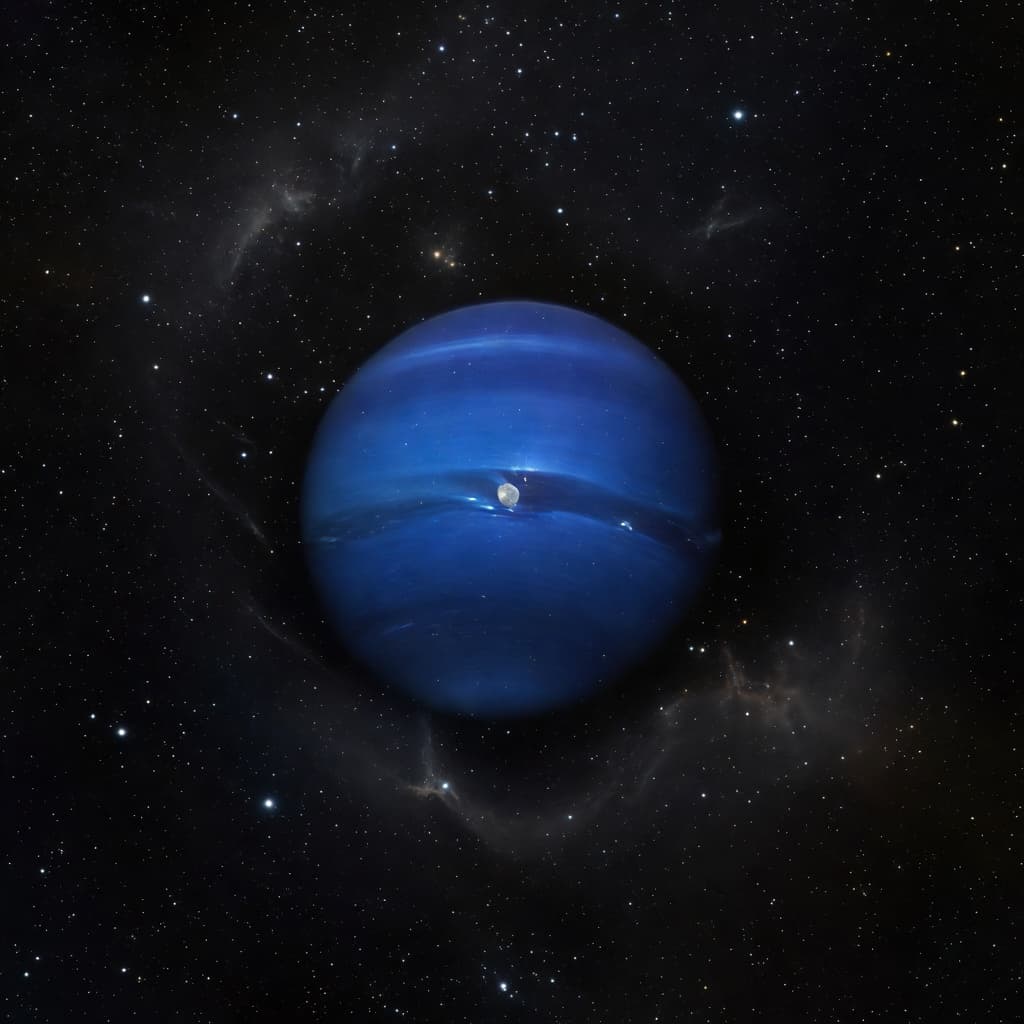
Neptune's third-largest moon has long been an enigma—and a new study from the James Webb Space Telescope provides a compelling answer to its origins. Nereid is likely the only surviving member of Neptune's original moon system, a lone holdover from a cataclysmic cosmic collision billions of years ago.
The Nereid Problem
Nereid is an oddity. Roughly 210 miles across, it orbits Neptune once every 360 days—but on an extraordinarily eccentric path, swinging from close approach to extreme distance. For decades, astronomers debated its origin:
- Was it captured from the Kuiper Belt, like Neptune's larger moon Triton?
- Or was it formed closer to Neptune in the distant past?
This peculiar orbit gave astronomers the clues that something violent had happened.
Neptune's "Moonpocalypse"
The answer lies in chaos. Billions of years ago, Neptune's system of regular moons (the type that form in orbit around their parent planet) met catastrophe when Triton—a large Kuiper Belt object—was captured by Neptune.
Triton's arrival triggered a gravitational reshuffling of epic proportions. Its retrograde (backward) orbit destabilized the inner moon system. Most of Neptune's original moons were either ejected entirely or crashed into Neptune. It was, in essence, a planetary cataclysm.
Nereid's eccentric, distant orbit is a signature of this violence—a moon flung outward and caught in an elongated path as the system reorganized around Triton.
The JWST Evidence
A research team led by Matthew Belyakov (Caltech) used the James Webb Space Telescope to analyze Nereid's reflected spectrum. What they found was striking:
Nereid shows a slightly bluer color and higher ice content compared to typical red, organic-rich objects from the Kuiper Belt. This composition is inconsistent with a captured origin—it looks more like a body that formed in situ near Neptune.
The team ran dynamical computer simulations modeling Triton's chaotic capture and its gravitational aftermath. In roughly 20% of scenarios, a moon similar to Nereid survived on a highly eccentric orbit exactly like Nereid's—providing a plausible pathway through chaos to its current state.
The Implication
Nereid likely stands alone as the only survivor of Neptune's original regular satellite system. Every other primordial moon that orbited Neptune in the early solar system either was destroyed or ejected during Triton's violent arrival.
It's a haunting thought: billions of years of isolation, the sole witness to Neptune's dark history, orbiting a world that destroyed its siblings.
Source: Science Advances - "Nereid as a regular satellite of Neptune"
Comments
Loading comments...