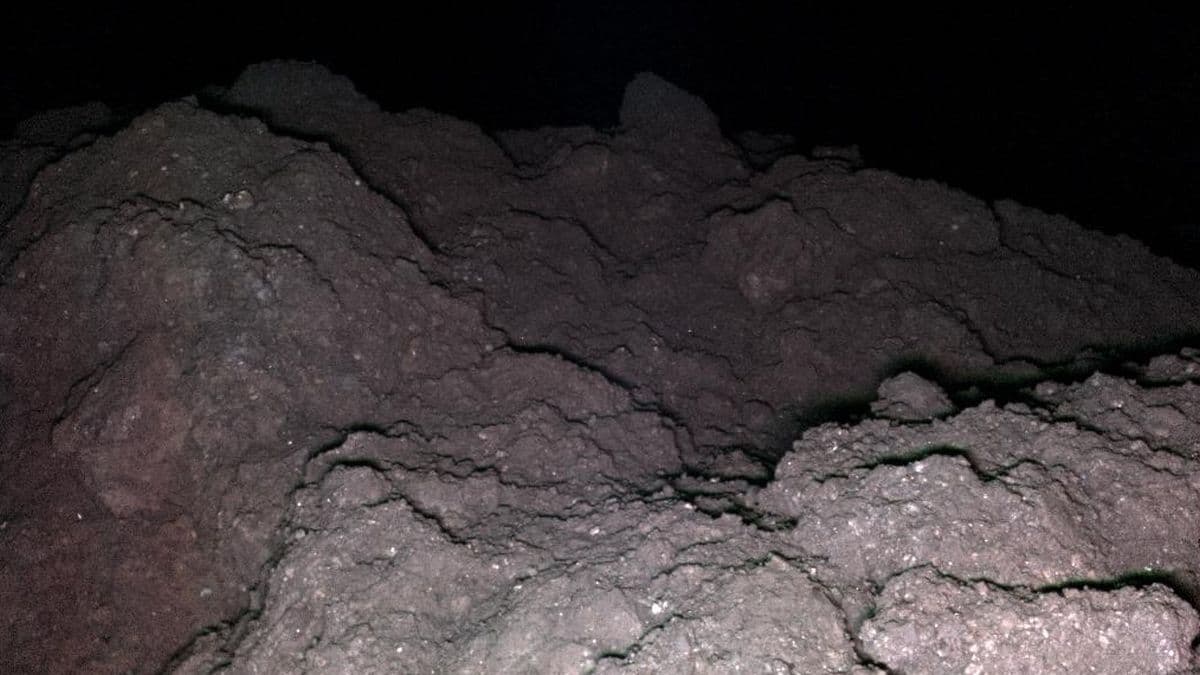
Asteroid Ryugu Reveals Complete Set of DNA's Building Blocks
In a groundbreaking discovery published in Nature Astronomy, an international team of researchers led by biogeochemist Toshiki Koga has confirmed that samples from asteroid Ryugu contain all five nucleobases—adenine, guanine, cytosine, thymine, and uracil—the fundamental molecular components of DNA and RNA.
Life's Blueprints in Space Dust
This discovery completes a picture that began when Japan's Hayabusa2 spacecraft collected pristine samples from Ryugu's surface in 2019 and returned them to Earth in 2020. Initial analysis in 2023 had detected only uracil, but more sophisticated analysis of two separate Ryugu samples has now revealed the complete molecular toolkit.
Equally exciting: asteroid Bennu, sampled by NASA's OSIRIS-REx mission, made the same discovery in January 2025. Two for two. The universal detection of all five nucleobases in samples from Ryugu and Bennu strongly suggests that these critical ingredients are not rare anomalies but rather common features of carbonaceous asteroids throughout the Solar System.
Chemistry Variations Tell a Story
Ryugu's nucleobase profile differs intriguingly from other meteorites and asteroids studied. The asteroid shows roughly equal amounts of purines (adenine, guanine) and pyrimidines (cytosine, thymine, uracil), whereas Bennu and the Orgueil meteorite are richer in pyrimidines, while the Murchison meteorite is richer in purines.
The researchers found that these differences correlate with ammonia levels in the samples, suggesting the chemical environment inside asteroid parent bodies—shaped by their history of heating, alteration, and chemical reactions—influences which nucleobases form preferentially.
Implications for the Origin of Life
The discovery strongly supports the hypothesis that carbonaceous asteroids delivered the prebiotic chemical inventory to early Earth. The presence of both thymine and uracil is particularly intriguing given the RNA World hypothesis, which suggests RNA emerged before DNA on primitive Earth.
"The detection of diverse nucleobases in asteroid and meteorite materials demonstrates their widespread presence throughout the Solar System, and reinforces the hypothesis that carbonaceous asteroids contributed to the prebiotic chemical inventory of early Earth," wrote Koga and colleagues.
This research underscores a profound truth: the ingredients for biology were not invented on Earth. They were synthesized in the cold darkness of the early Solar System, carried by asteroids across billions of kilometers, and delivered to our young planet on a cosmic conveyor belt.
Source: ScienceAlert - Asteroid Reveals The 5 Key Genetic Ingredients For Life on Earth
Comments
Loading comments...