Space
Starlink vs Stargazers: Inside the Battle Over the Night Sky
Starlink vs Stargazers: Inside the Battle Over the Night Sky
If you've watched the night sky in the past few years, you've probably seen them: a string of lights moving silently across the darkness in perfect formation. It's Starlink—and it's everywhere.
SpaceX's internet satellite constellation, now numbering over 9,000 active satellites with thousands more planned, has become impossible to ignore for one crucial community: astronomers. And as of 2026, the conflict between global internet access and the ability to study the cosmos is reaching a critical inflection point.
The Scale of the Problem
There are currently between 9,300 and 13,000 Starlink satellites in orbit at around 550 kilometers altitude. SpaceX plans to expand to 42,000 satellites. Competitors like Amazon Kuiper and OneWeb are launching their own constellations, targeting tens of thousands more.
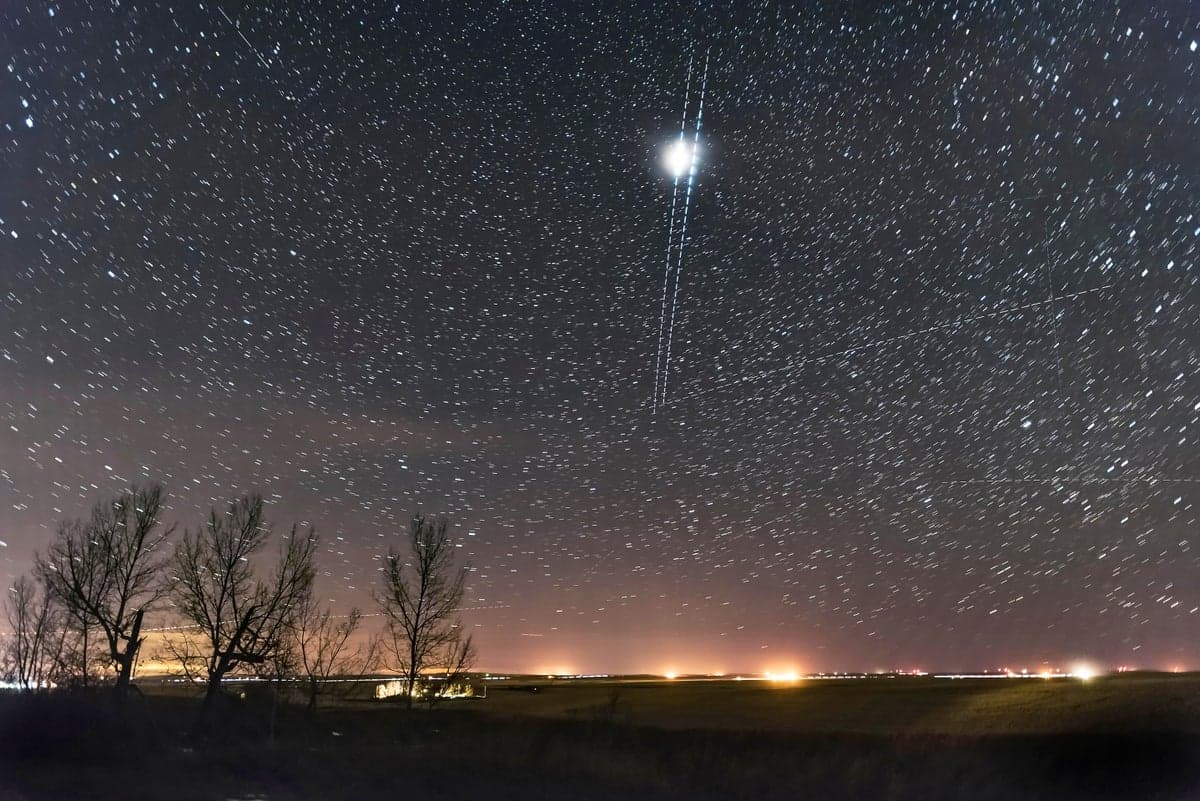
For casual stargazers, Starlink satellites are visible as bright "trains" shortly after launch, especially at dawn or dusk when the sun still illuminates them from space. They're striking, sometimes beautiful—but to a professional astronomer, they're catastrophic.
Why It Matters to Science
Imagine you're the Vera C. Rubin Observatory in Chile, designed to map billions of galaxies across the sky to understand dark matter, dark energy, and the universe's large-scale structure. Now imagine that your wide-field images are frequently photobombed by satellite streaks. A satellite moving across your field of view isn't just an annoyance—it's a data loss.
The problem scales exponentially. At lower orbital altitudes, simulations suggest that mega-constellations could compromise 40-96% of images from space-based observatories like Hubble. Radio telescopes face broadband interference from satellite antennas, literally blinding their ability to detect cosmic signals.
For astrophotographers like those using equipment similar to Stewart's Quattro 150P, Starlink trails become increasingly common in long-exposure images, especially from dark-sky sites at northern latitudes.
SpaceX's Response (and Its Limits)
Since 2019, SpaceX has worked with astronomers to mitigate the problem. They've implemented:
- Dielectric mirror films on flat surfaces of Gen2 satellites, reducing brightness by 10x compared to Gen1
- Low-reflectivity black paint on complex components, offering 5x improvement over standard space paints
- Darkened solar arrays that use edge-on orientation during twilight crossings (at a 25% power trade-off)
- Accurate ephemeris sharing so astronomers can predict satellite positions and subtract them from images
These efforts have worked. Newer Starlink satellites are often invisible to the naked eye during routine operations. But problems persist: glints from non-flat components still cause reflections, twilight visibility remains a challenge, and 40,000+ satellites will dwarf any mitigation efforts.
The Bigger Picture
This isn't just about pretty pictures. Astronomy drives discovery. The next breakthrough in understanding exoplanets, gravitational waves, or even alien life could require observations that mega-constellations make impossible. There's also the matter of principle: humans have studied the night sky for thousands of years. Is that era ending?
The UN's Committee on the Peaceful Uses of Outer Space (COPUOS) has called for global coordination on satellite mega-constellations, but enforcement is non-binding. It's the Wild West out there, and the rules are being written as satellites launch.
Some solutions are emerging: software that automatically removes satellite streaks from images, lower orbital altitudes (though this creates other problems like faster deorbiting), and improved design standards for future satellites. But full resolution? That's still years away.
What Happens Next
As of March 2026, SpaceX continues launching Starlinks. Amazon, OneWeb, and others aren't slowing down. Astronomers continue protesting, innovating, and adapting. It's an arms race between connectivity and discovery—and both sides have valid claims.
The night sky that inspired humanity for millennia is changing. Whether it's changing for better or worse depends on the decisions made in the next few years.
Source: Scientific American - Starlink and Astronomers Are in a Light Pollution Standoff
Comments
Loading comments...