June's Spectacular Planetary Conjunction: Venus, Jupiter, and Mercury Align
June's Spectacular Planetary Conjunction: Venus, Jupiter, and Mercury Align
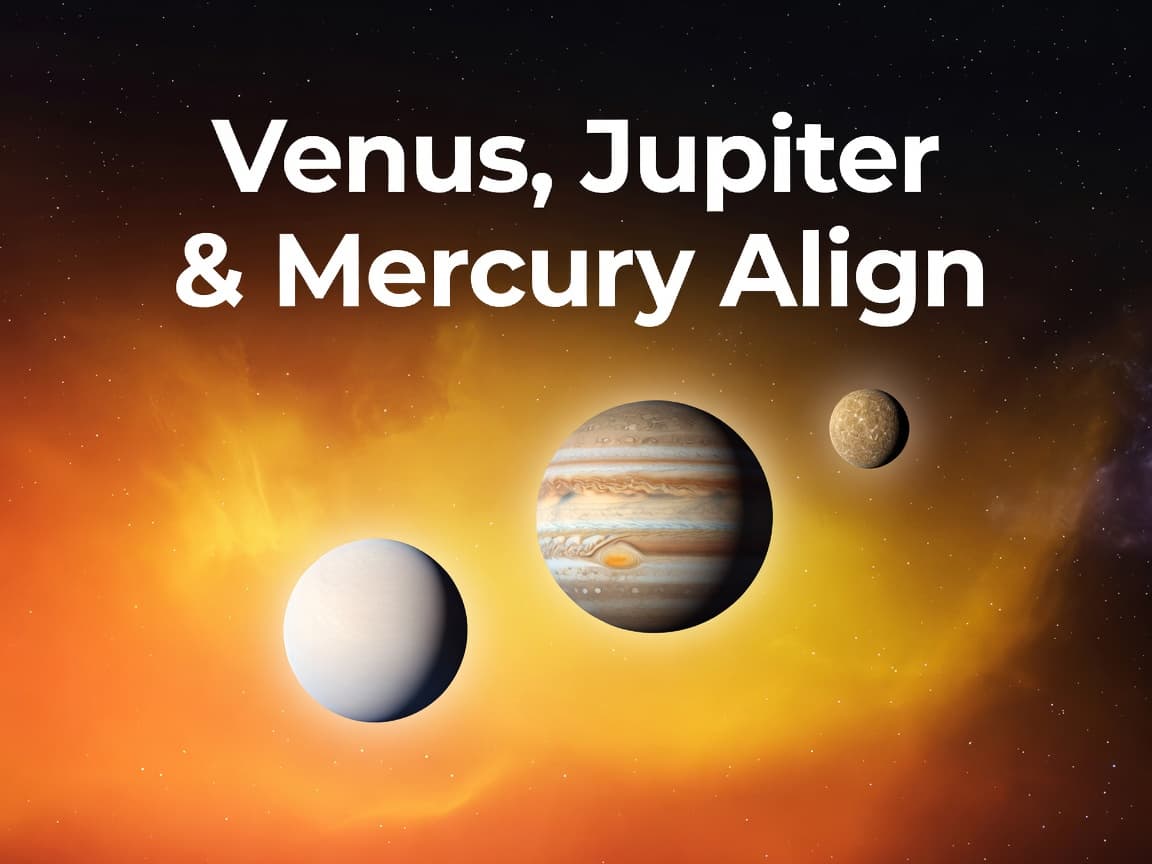
If you've been looking up at the evening sky lately, you've witnessed one of June's most remarkable astronomical events: a stunning alignment of the three brightest planets in the solar system.
The Event: A Triple Conjunction
For observers in the Northern Hemisphere, June 9-15 brought an exceptional planetary show in the western sky just after sunset:
- Venus and Jupiter: These two brightest planets appeared within about 1 degree of each other (roughly the width of your pinky finger held at arm's length) around June 9, creating a striking pairing.
- Mercury joins the show: By mid-month (June 11-15), Mercury entered the scene, forming a diagonal trio in the evening twilight. Mercury reached its greatest eastern elongation around June 12, offering optimal viewing conditions for this elusive planet.
- Constellation context: The pair appeared near the bright stars Castor and Pollux in Gemini, providing nice celestial landmarks for locating the planets.
Observing Conditions
For astrophotography enthusiasts, this event offered genuine challenge and reward:
- Naked eye: Easily visible without optical aid, though binoculars reveal color and detail beautifully. Venus's brilliant yellow-white, Jupiter's golden hue, and Mercury's subtle gray tone provide excellent color contrast.
- Telescopic viewing: Even modest telescopes (8-10 inches) could resolve Venus's crescent phase and Jupiter's cloud bands in the same field of view during closest approach.
- Astrophotography: The tight grouping made for compelling wide-angle compositions, capturing the planets against the fading twilight and surrounding stars.
The Science Behind Conjunctions
Planetary conjunctions occur when two or more planets align along the same line of sight from Earth—a geometric curiosity that has no physical significance (the planets remain millions of miles apart), but creates visually striking moments in our sky.
These events happen regularly: Venus-Jupiter conjunctions occur several times per decade, but the addition of Mercury, the brightest sky object nearby, makes triple-planet groupings rarer and more memorable.
Additional June Sky Events
The planetary show is just one part of June 2026's skywatching highlights:
- Moon-Venus occultation (around June 17): For observers in parts of the Americas, the Moon passes directly in front of Venus—a dramatic event where the planet disappears behind our satellite.
- Summer solstice (June 21): The astronomical marker for summer's beginning in the Northern Hemisphere.
- Strawberry Moon (around June 30): A full Moon, slightly smaller than average (a "micromoon"), marking month's end.
Why These Moments Matter
Beyond their immediate beauty, planetary conjunctions anchor us in the cosmos. They're reminders that we're not just observers on a static stage but participants in an active solar system—one where celestial bodies move in predictable, choreographed paths. That choreography, understood through physics and mathematics, is what lets us predict these moments years in advance.
For photographers and visual observers, conjunctions offer rare opportunities to capture planetary alignment and color contrast in ways that single-planet observation cannot match.
Source: NASA What's Up - June 2026
Comments
Loading comments...