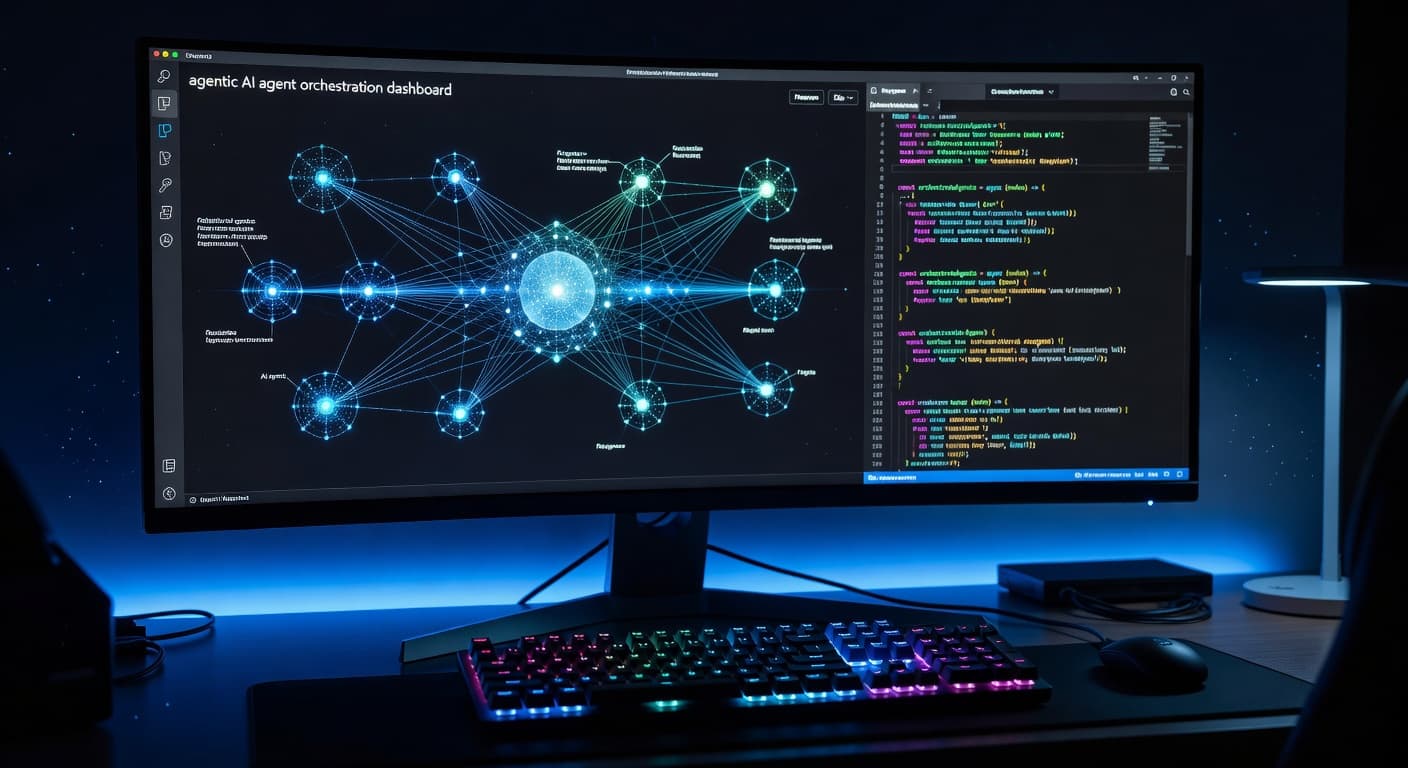
Agentic AI Takes Over Software Development in 2026
Agentic AI Takes Over Software Development in 2026
The era of writing code line-by-line is ending. In its place, a new paradigm is emerging: developers specifying intent, then orchestrating networks of AI agents to realize that intent.
According to Gartner, 40% of enterprise applications will integrate task-specific AI agents by the end of 2026—up from less than 5% a year ago. This isn't a gradual trend; it's a fundamental reshaping of how software gets built.
From Coding to Orchestration
The traditional software development workflow—architect, design, code, test, deploy—is being inverted. Today's best developers don't write more code; they write better intent specifications and orchestrate specialized agents to handle implementation, testing, optimization, and even debugging.
An AI coding agent can now write production-grade code in seconds. An AI testing agent can generate and execute comprehensive test suites. An AI operations agent can optimize deployment pipelines. A developer's job shifts from being a code factory to being a conductor—defining the symphony, then letting the orchestra play.
This creates a paradox: as AI handles routine coding, the role of the developer becomes more architectural, more creative, and more strategic. Commodity code work disappears. High-level design thinking becomes irreplaceable.
Multiagent Systems as the New Standard
Single AI models are giving way to networks of specialized agents. A financial services company might have agents for regulatory compliance, another for data validation, another for fraud detection—all coordinating autonomously on the same transaction.
Gartner predicts this multiagent architecture will become the backbone of 40% of new enterprise applications within months. Organizations that adopt these patterns gain extraordinary efficiency gains. Those that don't face intensifying pressure as their competitors ship 10x faster.
The Security and Governance Question
With AI agents making more autonomous decisions, security and governance become critical. Confidential computing—ensuring AI agents can't leak data—and digital provenance—verifying that AI outputs are correct—become primary concerns. DevSecOps practices move from best practice to baseline requirement.
What This Means for Developers
If you're writing boilerplate code, your job is disappearing. If you're designing systems, orchestrating agents, and solving novel problems—your skills are becoming more valuable by the day.
The best developers in 2026 aren't those who write the most lines of code. They're those who can define complex intent, orchestrate multiagent systems, and reason about emergent behavior in networks of AI agents.
The software industry is transitioning from a labor model to an intelligence model. Adapt accordingly.
Comments
Loading comments...