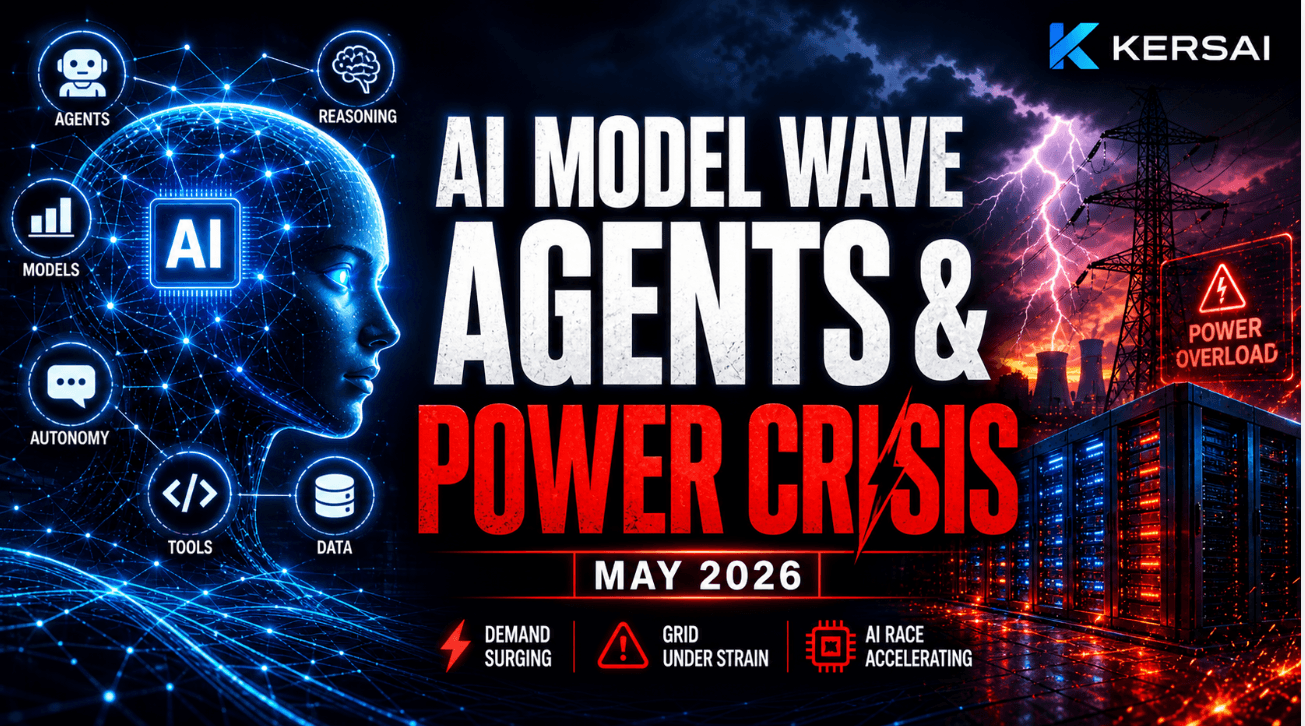
AI in May 2026: Frontier Models and the Agentic Shift
May 2026 is proving that April's AI shock was not a one-off event. Instead, the industry is accelerating into a new phase where model releases, agentic AI adoption, and infrastructure constraints are colliding simultaneously.
The Model Wave Continues
Three major developments are reshaping the frontier model landscape. GPT-5.5-Cyber is rolling out with a focus on security analysis and vulnerability discovery. Claude Mythos remains in restricted preview with roughly 50 partners, generating significant hype around advanced reasoning and autonomous execution. DeepSeek V4 is pushing frontier-class performance toward lower costs and open-weight economics, challenging the pricing assumptions that have dominated closed-model markets.
What's important is not just which model is "smartest"—it's that vendors are increasingly offering specialized variants rather than monolithic general-purpose systems. That signals where the highest-value use cases will emerge next.
The Agentic AI Inflection Point
The deeper shift in May 2026 is the rapid movement of agentic AI from hype cycle to enterprise planning. Gartner's forecast that 40% of enterprise applications will embed AI agents by end-2026 (up from under 5% in 2025) reflects this transition.
Agentic AI changes the conversation from intelligence as output to intelligence as workflow. It means AI is moving from answering questions toward coordinating actions, calling tools, and operating semi-autonomously across workflows. That requires different governance, different orchestration discipline, and different risk management than chatbot-style interfaces.
The Physical Constraint Nobody Expected
Here's the plot twist: AI progress is no longer constrained only by models or capital. It's constrained by physics.
Despite $650+ billion in combined hyperscaler capital expenditure, roughly half of planned U.S. data-centre projects this year are delayed or cancelled due to power infrastructure and component shortages. Substations need to be built. Transformers need to be sourced. Grid interconnection queues need to clear. Transmission infrastructure needs to expand.
This is an industrial coordination problem, not a software update. And industrial coordination moves much more slowly than frontier model releases.
What This Means for Builders
The organisations that will win in the second half of 2026 aren't those chasing the loudest model release or the most hyped AI framework. They're the ones asking harder questions:
- Which use cases justify frontier models vs. cheaper alternatives?
- How should agentic workflows be governed at scale?
- What is our exposure to vendor concentration and infrastructure bottlenecks?
- How should security and safety controls evolve as model capabilities advance?
The AI market is moving from "what can the next model do?" to "what can we actually deploy, trust, govern and afford?" That's where the real business wins happen.
Source: Kersai Research — AI in May 2026
Comments
Loading comments...