Affordable Humanoid Robot Legs Democratize AI Robotics Research
Affordable Humanoid Robot Legs Democratize AI Robotics Research
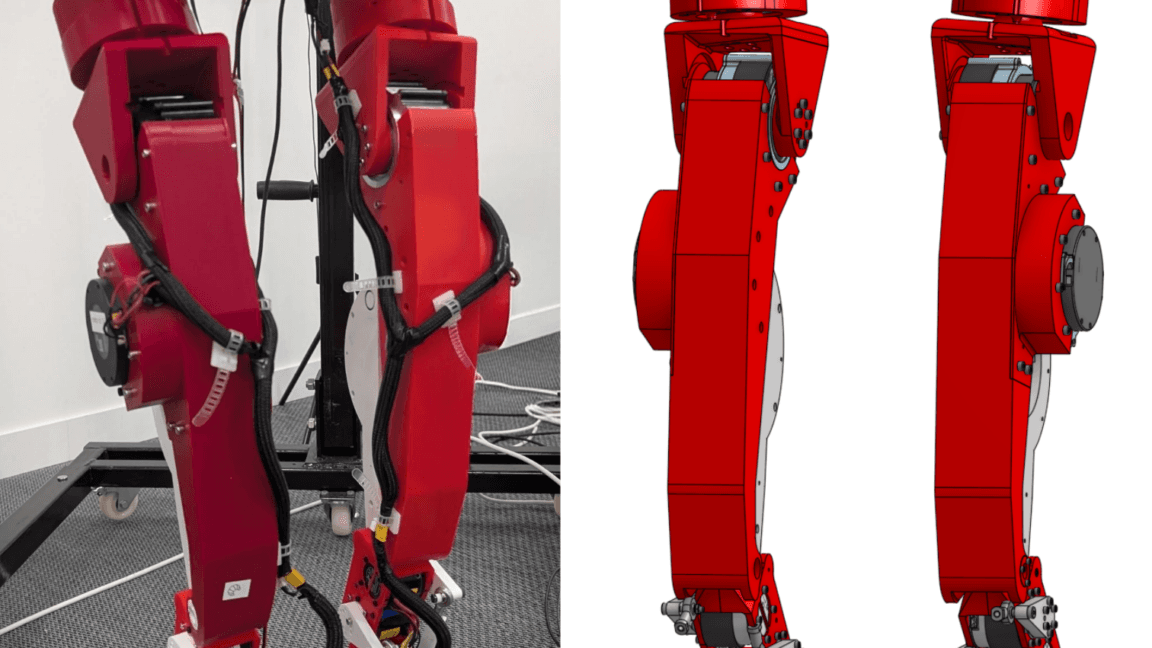
Hugging Face, the machine learning platform behind some of the most widely-used open source AI models, has released a new project that could democratize robotics research: the LeRobot Humanoid—a fully 3D-printable bipedal robot that costs just $2,500 to build.
The platform provides everything needed to assemble, calibrate, and control a working humanoid robot: CAD files for 3D-printed components, bills of materials, wiring diagrams, assembly instructions, and open source software for both physical robots and simulation environments.
"If you are looking for the most advanced humanoid robot, this is not it," wrote Virgile Batto, a robotics engineer at Hugging Face, in the project announcement. "If you are looking for a humanoid you can build, understand, repair, instrument, simulate, and use for learning experiments, this is the robot we are trying to make."
Breaking the Cost Barrier
Commercial humanoid robots currently cost between $30,000 and $150,000 per unit—a price that puts serious robotics research out of reach for most universities, startups, and individual researchers. Chinese companies like Unitree Robotics are pushing costs lower with models under $20,000, but even those are beyond the budgets of most academic labs.
The LeRobot Humanoid legs target a different market: researchers who want to move beyond simulation and test AI algorithms in physical embodiment without breaking the bank. At $2,500, they're affordable enough that a lab could build multiple units to parallelize experiments or recover from prototype failures without devastating equipment budgets.
Design Philosophy: Repairable, Modifiable, Reproducible
The design prioritizes practicality over performance. Built around affordable actuators, off-the-shelf electronics, and components that can be 3D-printed on standard FDM printers, the LeRobot Humanoid can be easily modified and repaired by anyone with basic mechanical skills.
This matters for research. When your robot fails during an experiment, you're not stuck waiting weeks for a replacement or dealing with expensive service contracts. You print a new part, swap it out, and continue working.
The system also enables a "full-robot design loop" where simulations inform physical prototypes, and physical experiments generate training data that improves simulations. This virtuous cycle is essential for developing AI algorithms that work reliably in the real world—a gap that's still significant in robotics today.
Part of a Larger Robotics Push
The LeRobot Humanoid legs are just the first phase of Hugging Face's robotics roadmap. The company previously released 3D-printable robotic arms and has announced plans to integrate an upper body for future releases. Hugging Face is also working with French robotics company The Robot Studio on the HopeJR humanoid—a more sophisticated platform with 66 degrees of freedom and a target price of $3,000.
This strategy reflects Hugging Face CEO Clem Delangue's stated goal: making robotics affordable while preventing market dominance by large corporate players. As venture capital flooding into robotics surpasses $40 billion (up from $13 billion in 2023), the cost of entry for cutting-edge hardware remains prohibitively high for most researchers.
The Broader Landscape
The timing is significant. Hyundai Motor Group is reportedly building manufacturing capacity for Boston Dynamics' Atlas humanoid, with plans for 350,000 robotic actuators annually at a facility in Georgia. Chinese companies are undercutting Western competitors on price, though some are experiencing margin pressure as the market matures.
Meanwhile, OpenAI, Anthropic, and other AI companies are increasingly interested in robotics as a domain where their models can be grounded in physical interaction. The cost of the robot hardware shouldn't be the limiting factor in that research.
With the LeRobot Humanoid, Hugging Face is making sure it won't be.
Source: Ars Technica
Comments
Loading comments...