Space
Artemis II: NASA's Historic Return to the Moon
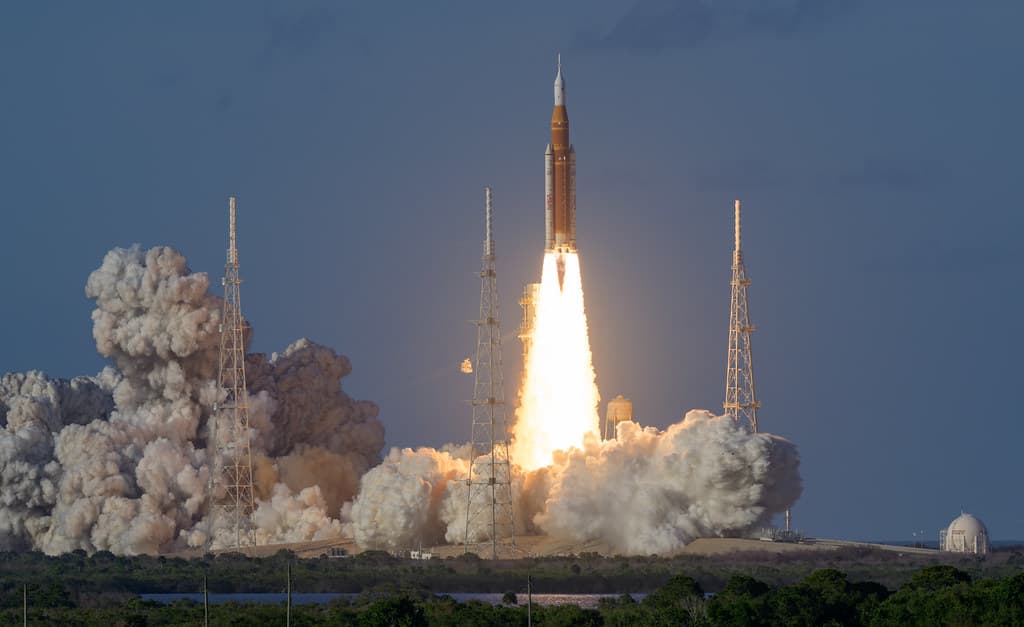
Spurred by American ingenuity and precision, NASA's Artemis II mission marked a defining moment in space exploration on April 1st, 2026, when the Space Launch System (SLS) rocket lifted off from Kennedy Space Center carrying four astronauts aboard the Orion spacecraft for the first crewed lunar mission in more than 50 years.
The Mission
Reid Wiseman, Victor Glover, and Christina Koch from NASA, joined by Canadian astronaut Jeremy Hansen, embarked on a 10-day test flight that would take them farther and faster than any human in a generation. The SLS rocket's upper stage performed flawlessly, placing Orion into high Earth orbit where the crew conducted system checks and demonstrated manual piloting capabilities.
On April 6th, the spacecraft performed a translunar injection burn—a critical six-minute firing that sent Orion on a trajectory around the Moon, harnessing lunar gravity to slingshot the crew back to Earth. During the lunar flyby, the astronauts captured photographs of the Moon's far side, observing surface features that are rarely visible from Earth due to illumination angles. The spacecraft maintained a trajectory that brought it within ideal distance to study the lunar landscape while conducting critical human health investigations.
Why It Matters
Artemis II serves as a crucial proof-of-concept for NASA's plan to return humans to the lunar surface with future Artemis missions. The flight validated life support systems with crew aboard for the first time, tested Orion's heat shield during re-entry, and demonstrated the engineering required for sustained lunar exploration.
The mission also represents a step toward the agency's broader goals: establishing a Moon Base and eventually sending crewed missions to Mars. By successfully executing this test mission, NASA has shown that the infrastructure, vehicles, and procedures are ready for the next phase of exploration.
Safe Return
After splashing down safely in the Pacific Ocean on April 10th, the crew and recovered spacecraft vindicated years of careful engineering and testing. The mission's success has energized the space exploration community and set the stage for increasingly ambitious lunar missions in the coming years.
For Stewart, this mission resonates with humanity's enduring drive to explore—the same spirit that compels backyard astrophotography and the search for understanding the cosmos.
Source: NASA Official Press Release
Comments
Loading comments...