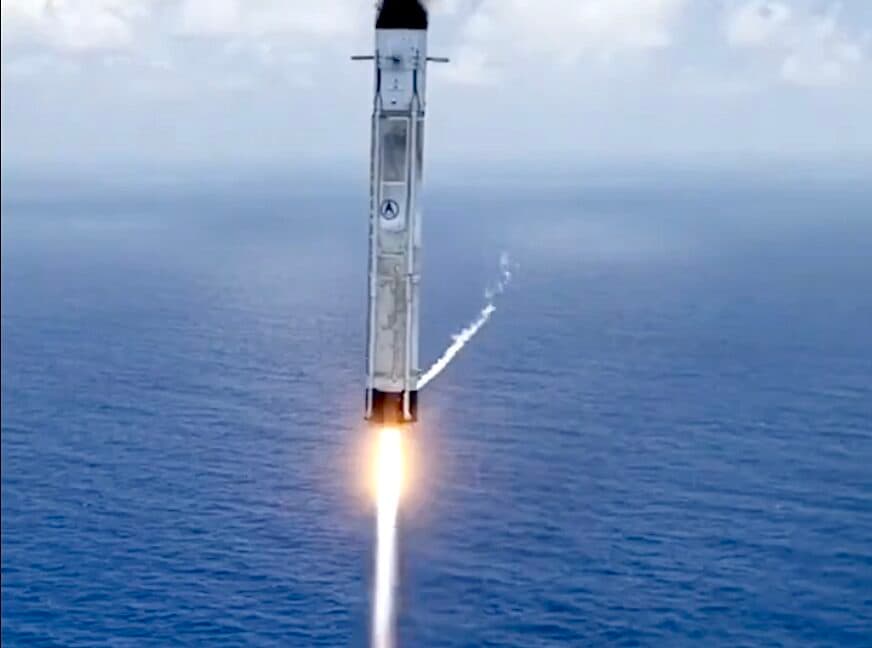
China's Long March 10B Joins the Reusable Rocket Club
China has achieved a major milestone in its space program: successfully recovering its first reusable orbital-class rocket booster. The Long March 10B, a medium-lift vehicle with around 16 metric tons of payload capacity to low-Earth orbit, lifted off from Wenchang Spaceport on Hainan Island on July 10, 2026, and executed a controlled landing on an offshore recovery vessel in the South China Sea.
A Different Approach to Rocket Recovery
What makes China's recovery technique distinctive is the methodology. Rather than propulsive landings on fixed platforms (SpaceX's Falcon 9 approach) or mid-air catches at the launch tower (SpaceX Starship), the Long March 10B uses a net-based capture system deployed on a moving ocean platform. The booster descends under controlled power, with tensioned cables stretched in a grid pattern above the vessel to cushion the landing. This approach reduces the payload capacity penalty compared to landing legs, as the rocket doesn't need to carry extra mass for landing gear.
The test flight validated critical technologies for reusable launch architecture: multi-engine restarts at high altitude, precision navigation and control, and the novel sea-based net recovery system. CASC (China Aerospace Science and Technology Corporation) announced plans to conduct the first reuse flight test by the end of 2026.
Strategic Implications
This achievement is significant for several reasons. China is now the third operator globally to master orbital booster recovery—after SpaceX (Falcon 9 in 2015, Starship in 2024) and Blue Origin (New Glenn last November). The Long March 10B is comparable in lift capacity to SpaceX's Falcon 9, capable of deploying roughly 16 metric tons to LEO.
More importantly, the Long March 10B is a stepping stone to larger vehicles. The Long March 10A (awaiting its own test flight) will eventually support crew launches to China's Tiangong space station aboard the new Mengzhou spacecraft. The full Long March 10 configuration—comprising three booster cores clustered together—will be central to China's lunar program, with an ambitious target to land Chinese astronauts on the Moon by 2030.
US military analysts have flagged reusable rocketry as a key differentiator in space competitiveness. General Brian Sidari, the Space Force's deputy chief of space operations for intelligence, noted last year that "the Chinese figuring out how to do reusable lift" could enable them to field more satellites faster than the US currently can. SpaceX's rapid launch cadence—enabled by Falcon 9 reusability—underpins critical US military capabilities including Starlink, Starshield, and emerging space-based sensing networks.
The Next Frontier
As Charles Galbreath, a retired Space Force colonel and space policy analyst at the Mitchell Institute, told ArsTechnica: "Clearly, they admire the work that's being done by SpaceX and are trying to replicate it, and at the same time take it away from the United States if it ever came to it."
The real question now is execution speed. Can China scale reusable operations to the kind of cadence that makes a strategic difference? Multiple Chinese commercial companies are also pursuing rocket reusability. Meanwhile, rival space powers in Japan, Taiwan, and India are investing heavily in their own capabilities. The reusable rocket race is accelerating.
Source: ArsTechnica
Comments
Loading comments...