Space
Hubble Witnesses Comet Reverse Its Spin—First Time Ever Observed
Hubble Witnesses Comet Reverse Its Spin—First Time Ever Observed
For the first time, astronomers have watched a comet slow its rotation, reverse direction entirely, and then spin up in the opposite direction. The culprit? Jets of gas and dust erupting from the comet's surface as it approached the sun. The discovery reveals that small bodies in the solar system are far more dynamic than previously thought.
The Spinning Comet
Comet 41P/Tuttle–Giacobini–Kresák is a Jupiter-family comet with a 5.4-year orbit. When it passed closest to the sun in September 2022, it created outbursts of activity that left visible traces in observations taken across multiple telescopes—including NASA's Hubble Space Telescope, the Neil Gehrels Swift Observatory, and the Lowell Discovery Telescope in Arizona.
But the real story came from comparing observations across time. In March 2017, the Lowell Discovery Telescope measured the comet's rotation period at roughly 14 hours. By May, when Swift observed it, that period had slowed to between 46 and 60 hours—about three times slower. Then, by December 2017, Hubble showed the rotation had sped up again, back to around 14 hours.
The kicker: the rotation had reversed direction entirely.
Jets as Tiny Thrusters
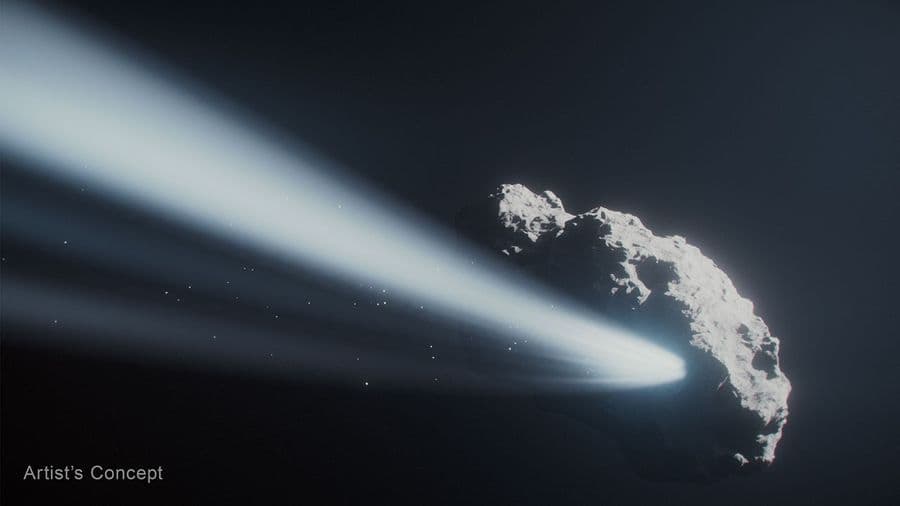
Planetary scientist David Jewitt of UCLA pieced together what happened. As the comet approached perihelion—its closest point to the sun—heat expanded volatile ices near its surface, causing them to burst outward in jets. These weren't gentle puffs; they were violent enough to act as thrusters.
"Jets of gas streaming off the surface can act like small thrusters," Jewitt explained. "If those jets are unevenly distributed, they can dramatically change how a comet, especially a small one, rotates."
Think of it like a merry-go-round. If you push against its direction of rotation, you'll slow it down. Keep pushing, and you'll reverse it. That's exactly what happened to 41P's tiny 0.6-mile-wide nucleus.
A Comet on Its Way Out
The observations reveal something darker: 41P may not survive much longer. Compared to Hubble observations from 2001, the comet's activity at perihelion has decreased dramatically—by roughly an order of magnitude. Repeated passes near the sun may be depleting its supply of volatile ices, or dust from previous outbursts may be coating those ices, insulating them from solar heating.
If the changes in spin continue, Jewitt predicts, the accelerating rotation will create centrifugal forces strong enough to tear the nucleus apart.
"I expect this nucleus will very quickly self-destruct," he said.
The discovery was published on March 26, 2026, in The Astronomical Journal, and it underscores how much we still have to learn about comets—small bodies that turn out to be surprisingly violent and unpredictable.
Source: NASA Science – NASA's Hubble Detects First Ever Spin Reversal of Tiny Comet
Comments
Loading comments...