Space
Webb and Hubble Team Up for the Sharpest View of Saturn Ever Created
Webb and Hubble Team Up for the Sharpest View of Saturn Ever Created
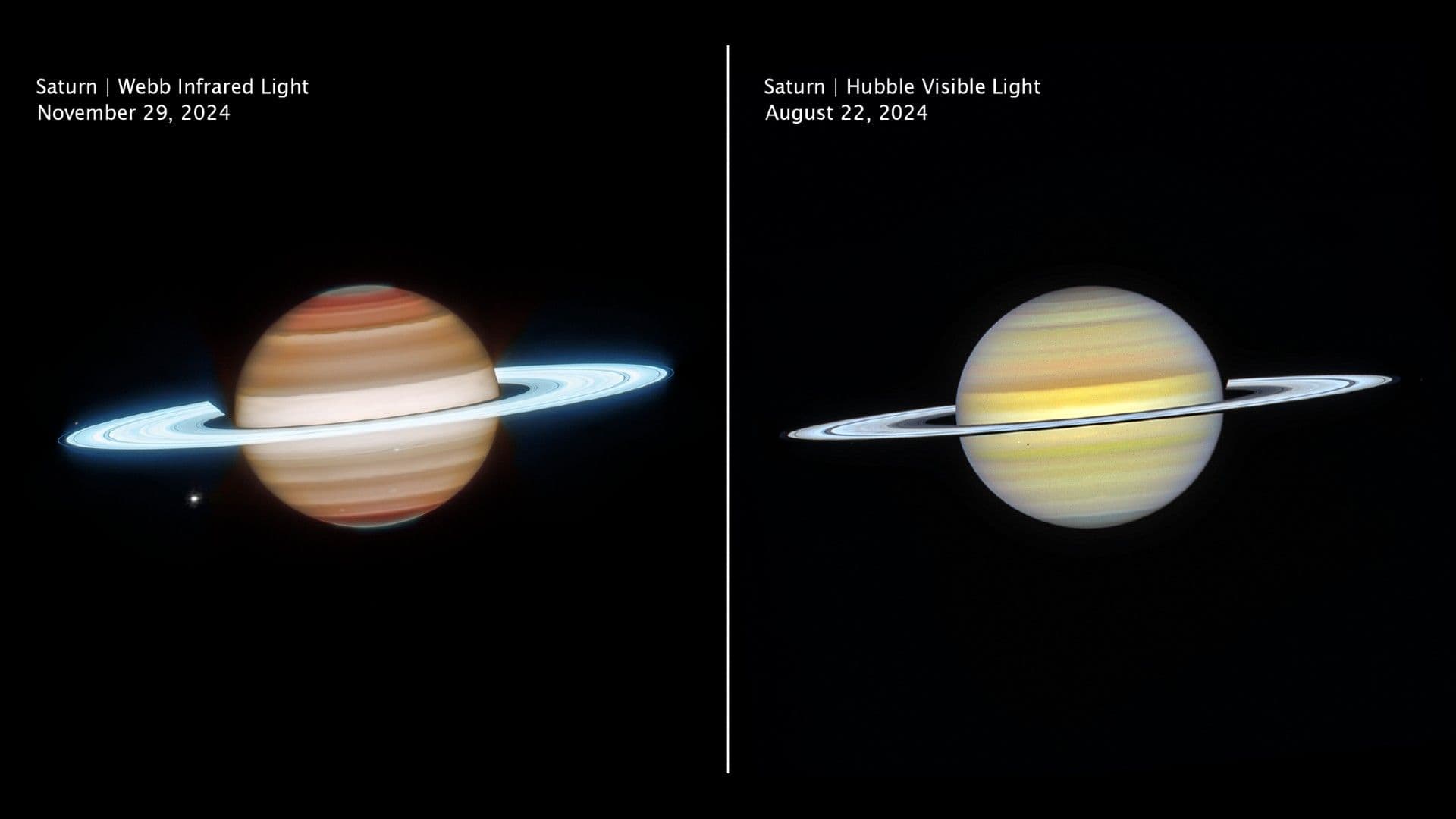
In what may be the clearest portrait of the ringed planet ever captured, NASA has combined observations from the James Webb Space Telescope and the Hubble Space Telescope to create a stunning multiwavelength view of Saturn. By blending infrared, visible, and ultraviolet light, the two observatories have revealed layers of Saturn's atmosphere and ring system that neither could capture alone.
Complementary Views, Complementary Science
Each telescope brings distinct strengths to the table. Hubble captures sharp, long-term visible-light observations of Saturn's cloud bands and atmospheric changes—data that spans over a decade as part of the Outer Planet Atmospheres Legacy (OPAL) program. Webb, observing in infrared wavelengths, peers deeper beneath the cloud tops, revealing heat patterns and atmospheric structures invisible to visible light.
The comparison is striking: Hubble shows Saturn's soft, banded appearance with rings bright in reflected sunlight. Webb's infrared view makes the rings stand out even more dramatically, appearing as sharp, well-defined structures against space. Subtle details emerge—ring spokes and structure in the dense central region become apparent when viewed across wavelengths.
What the Data Reveals
Hubble's observations, captured in August 2024, documented Saturn in the later stages of northern summer, while Webb followed 14 weeks later. This timing matters: Saturn's seasonal cycles last about seven Earth years, and tracking the atmosphere across multiple observations helps scientists understand how the planet's weather systems evolve.
The combined dataset shows a more complete picture of Saturn's dynamic atmosphere. Webb reveals meandering jet streams in the northern mid-latitudes, possible auroral activity, and scattered storms across the southern hemisphere—features that would be hidden from visible-light observation alone.
For anyone interested in planetary science and space telescopes, this collaboration demonstrates why multiple observatories are more powerful than the sum of their parts. The infrared penetration that JWST provides, combined with Hubble's decades of continuous visible-light tracking, creates a far richer dataset for understanding how gas giant atmospheres work.
A Preview of Future Observations
As both observatories continue their missions, researchers plan to build on these observations, tracking Saturn's evolution toward its 2025 equinox. Each observation adds another data point to the long-term record, revealing not just what Saturn is, but how it changes across time and wavelength.
Saturn isn't just a distant point of light anymore—it's a dynamic, layered world whose hidden structure is finally coming into focus.
Source: NASA Science – Webb and Hubble Share Most Comprehensive View of Saturn to Date
Comments
Loading comments...