Space
NASA's DART Mission Did More Than Anyone Expected — It Moved an Asteroid's Orbit Around the Sun
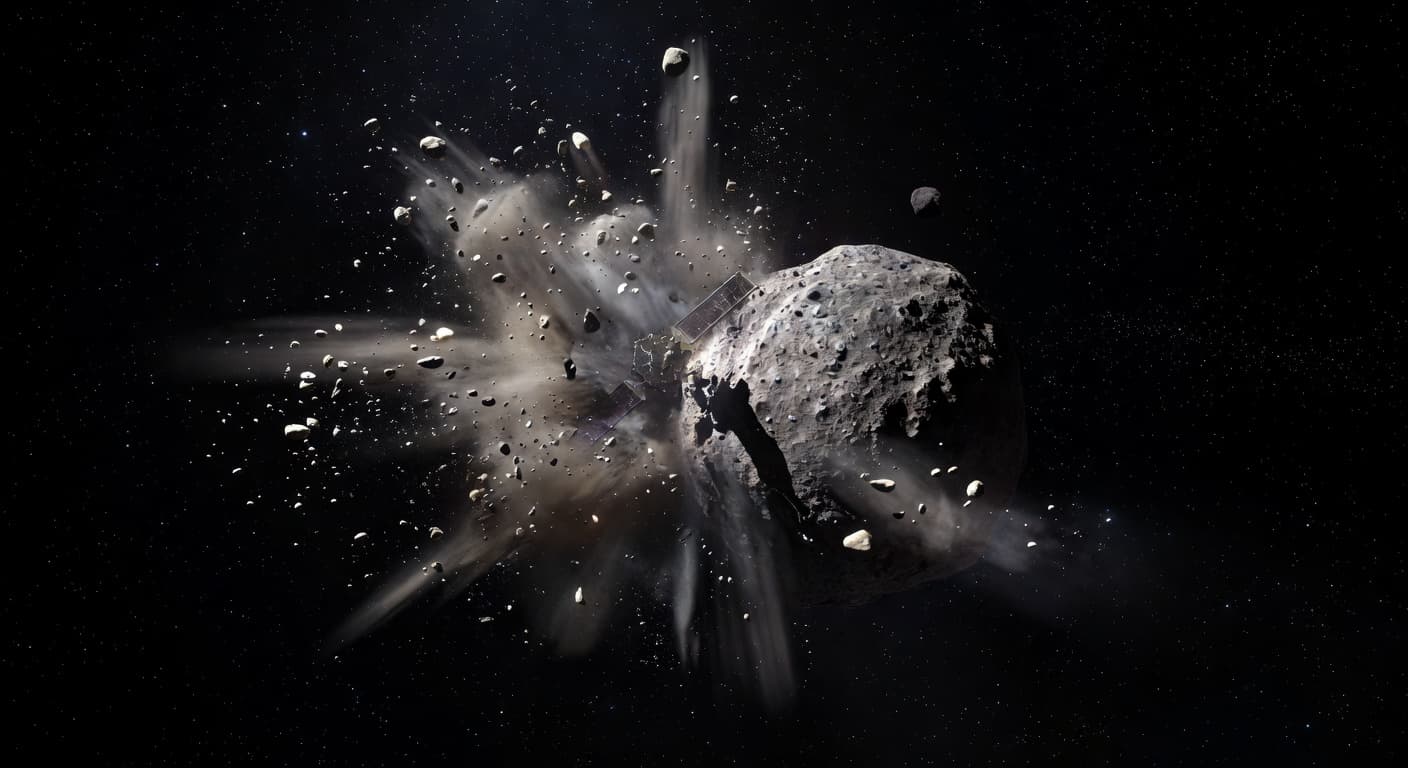
When NASA's DART spacecraft deliberately smashed into the asteroid Dimorphos in September 2022, the mission was hailed as a success almost immediately. Dimorphos's orbital period around its parent asteroid Didymos shortened by 33 minutes — far more than scientists had predicted. Planetary defence, it seemed, was viable.
Now, new analysis published in March 2026 reveals the impact did even more than that.
The Orbit Around the Sun
Researcher Keith Cooper, writing for Space.com, reports that new studies show the DART impact also altered the orbital path of the entire Didymos binary system around the Sun. The momentum transfer from the spacecraft — and crucially, the enormous plume of debris ejected from the impact — gave the twin-asteroid system a measurable kick along its solar orbit.
This is a more significant finding than it might initially appear. Planetary defence scenarios don't just require moving a moon around its parent body — they require changing an asteroid's path relative to Earth. This confirmation that DART produced a solar-orbit-scale perturbation is direct evidence that the technique works at the scale that actually matters.
Why It Proves Planetary Defence is Real
The DART mission was always framed as a test. Didymos and Dimorphos posed no actual threat to Earth — they were a convenient target for a proof-of-concept. The question being tested: could humanity deflect a hazardous asteroid if we had to?
The answer, based on this latest analysis, is yes — with a significant caveat. "So long as we discover it in the nick of time," Cooper notes. The lead time required for deflection to work is measured in years, ideally decades. A last-minute DART-style mission against a fast-approaching impactor would not move the needle enough.
Early detection remains the critical bottleneck. The upcoming Vera Rubin Observatory, which begins full survey operations in 2026, is expected to dramatically expand the catalogue of known near-Earth objects — giving humanity more of that precious lead time.
For now though: we hit an asteroid with a spacecraft and moved it. Both it and its parent body. That's not nothing.
Source: Space.com
Comments
Loading comments...