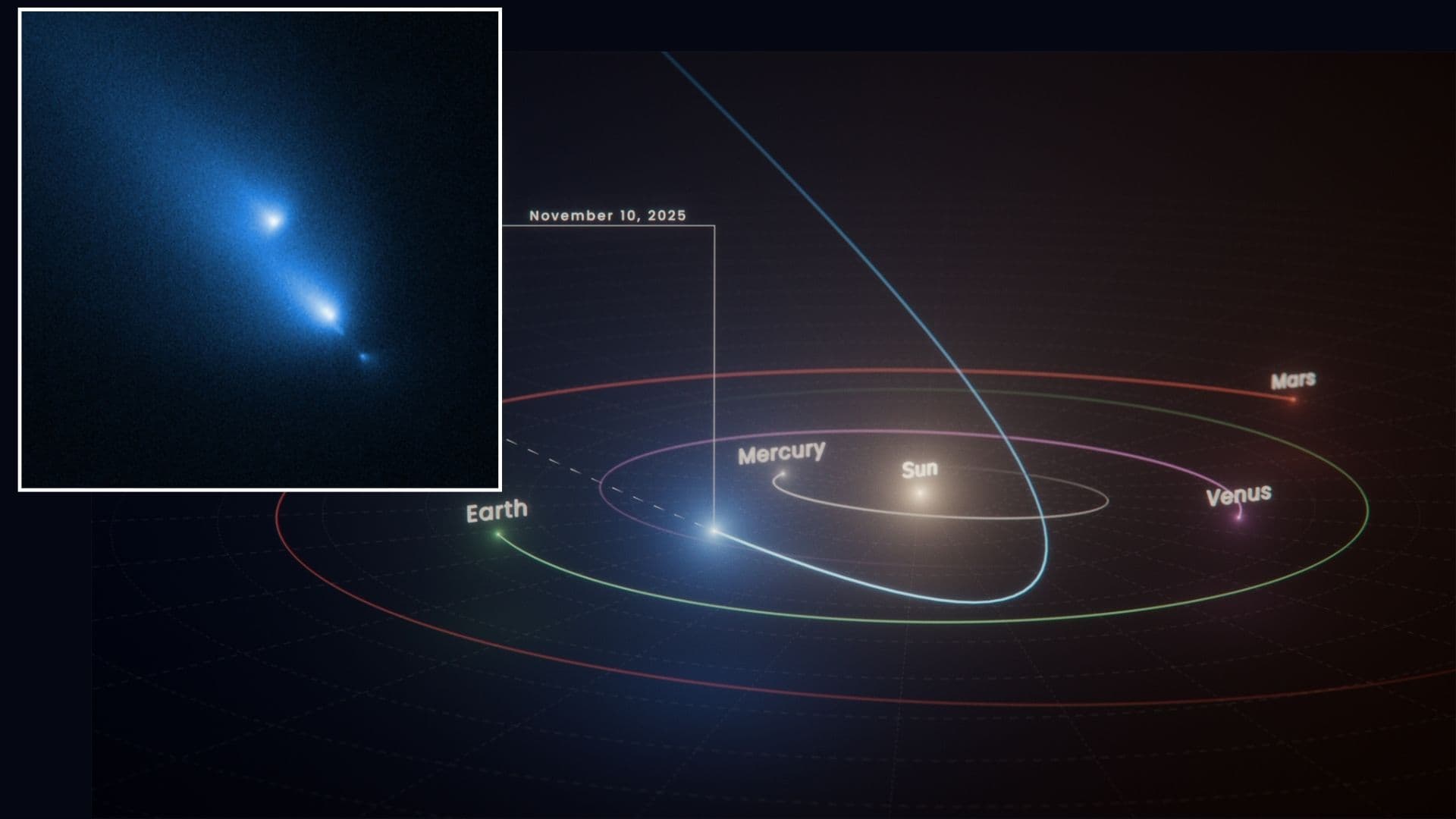
Hubble Witnesses Comet Breaking Apart in Real Time
NASA's Hubble Space Telescope has captured one of astronomy's rarest moments: a comet actively breaking apart in real time.
The Discovery
During a routine observation of the cosmos, Hubble spotted Comet C/2025 K1 (ATLAS) – or K1 for short – fragmenting in real-time. The telescope captured images over three consecutive days (November 8-10, 2025) showing the comet splitting into at least four pieces, each with its own glowing coma of gas and dust.
Remarkably, this was completely unexpected. Researchers were originally observing a different comet when new technical constraints forced them to find an alternative target. K1 became the substitute – and broke apart just days after their observation began. A rare stroke of cosmic luck.
The Physics of Fragmentation
K1 is what astronomers call a "dirty snowball" – a loose conglomeration of ice, dust, and rock held together by gravity alone. At roughly 5 miles (8 kilometers) across, it originated from the Oort Cloud, the icy graveyard at the edge of our solar system where comets spend billions of years in hibernation.
As the comet swung past the sun at perihelion, solar heating intensified. Frozen volatiles sublimated into gas, creating jets that pushed outward. Combined with internal structural weaknesses, these stresses caused the nucleus to fracture – likely beginning about a week before Hubble's observations.
A Mystery Within the Breakup
Here's where it gets interesting: despite fragmenting, K1 didn't brighten immediately as expected. Usually, when a comet breaks apart, fresh ice exposed to sunlight causes it to flare dramatically. But K1 remained dim for days after breaking up.
Scientists suspect this delay reveals something important about cometary surface physics. Freshly exposed ice may need time to develop a dust layer – that dust is what reflects sunlight and creates the brightness we see. Or heat may need to build beneath the surface before ejecting material. Either way, K1 is offering a window into the timescale of these processes.
"This is telling us something very important about the physics of what's happening at the comet's surface," said Auburn University physicist John Noonan. "We may be seeing the timescale it takes to form a substantial dust layer that can then be ejected by the gas."
Why This Matters
Comet breakups are unpredictable and usually too distant to observe in detail. Hubble's high resolution allowed scientists to track the fragments as they drifted apart – revealing the mechanics of an ancient object's demise. As K1's pieces fade and scatter into space, they're offering a rare, fleeting view of how the solar system's oldest objects evolve.
The findings were published in February 2026 in the journal Icarus.
Source: NASA – Hubble Space Telescope
Comments
Loading comments...