Hubble Captures Rare Moment of Comet Breaking Apart in Space
Hubble Captures Rare Moment of Comet Breaking Apart in Space
Sometimes the best science happens by accident. NASA's Hubble Space Telescope has done exactly that, serendipitously capturing one of the rarest astronomical events: a comet fragmenting into pieces in real time. The discovery, published in Icarus, offers astronomers an unprecedented window into the primordial materials that formed our solar system.
The Accident that Led to Discovery
The observation wasn't planned. The Hubble team had originally proposed observing a different comet, but technical constraints forced them to identify a new target at the last minute. When they switched focus to comet C/2025 K1 (ATLAS), they had no idea they were about to witness something extraordinary.
"While I was taking an initial look at the data, I saw that there were four comets in those images when we only proposed to look at one," said co-investigator John Noonan of Auburn University. "So we knew this was something really, really special."
A Comet Cracks Open
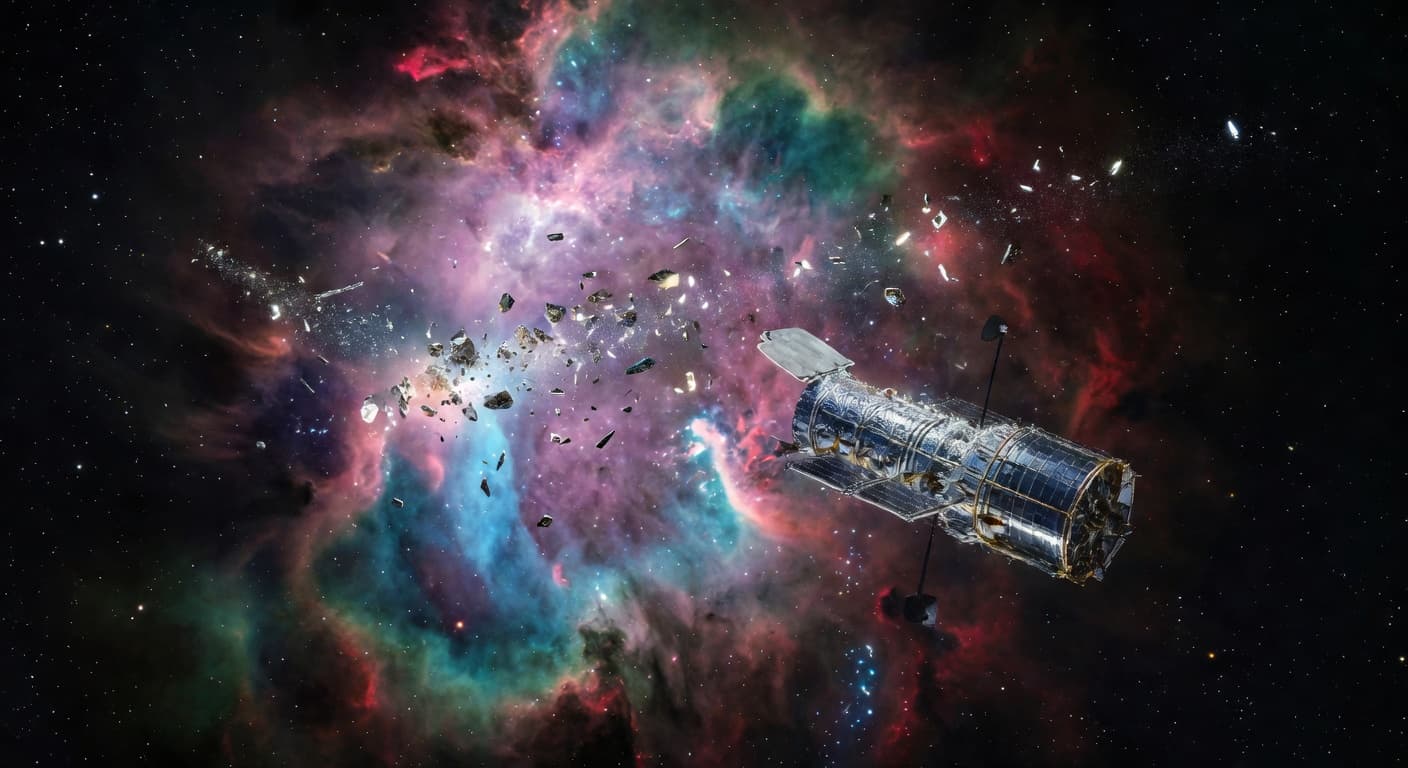
Hubble captured the fragmentation event in November 2025, observing K1 breaking into at least four separate pieces, each surrounded by its own coma—the glowing cloud of gas and dust characteristic of active comets. Ground-based telescopes detected only faint, barely-separated points of light, but Hubble's high-resolution imaging clearly resolved the individual fragments.
The breakup likely started about eight days before Hubble's observations, triggered by the intense heat from the Sun. K1 had ventured inside Mercury's orbit—one-third of the way from Earth to the Sun—placing it in the most severe thermal stress zone of its journey.
A Glimpse of Ancient Material
Why does this matter? Comets are pristine remnants of the solar system's formation, containing material largely unchanged for 4.5 billion years. But unlike meteorites found on Earth, comets haven't been chemically processed by planetary environments.
"By cracking open a comet, you can see the ancient material that has not been processed," explained principal investigator Dennis Bodewits. When a comet splits open, it exposes fresh subsurface ice—the most primitive stuff of the solar system—offering chemists and astrophysicists a direct window into our cosmic origins.
An Unexplained Mystery
But the discovery raised new questions. Scientists expected the exposed fresh ice to produce a bright outburst of reflected sunlight and dust immediately. Instead, there was a puzzling delay. Hubble's observations show the fragmentation clearly, yet the brightness spike detected from Earth came later.
Researchers have proposed several theories: perhaps a dry dust layer must form and blow off first, or perhaps heat penetrates deep beneath the surface, building pressure that eventually releases a shell of dust into space. Future analysis may solve this puzzle.
Why This Matters
Fragmenting comets are notoriously difficult to observe at the right moment. Scientists had submitted multiple Hubble proposals hoping to catch such an event, but timing is nearly impossible to predict. This accidental discovery represents a rare gift to astronomy—a natural experiment that researchers could never have planned but desperately wanted to witness.
The data will fuel research into cometary physics for years to come.
Source: ScienceDaily — NASA's Hubble accidentally caught a comet breaking apart in real time
Comments
Loading comments...