Space
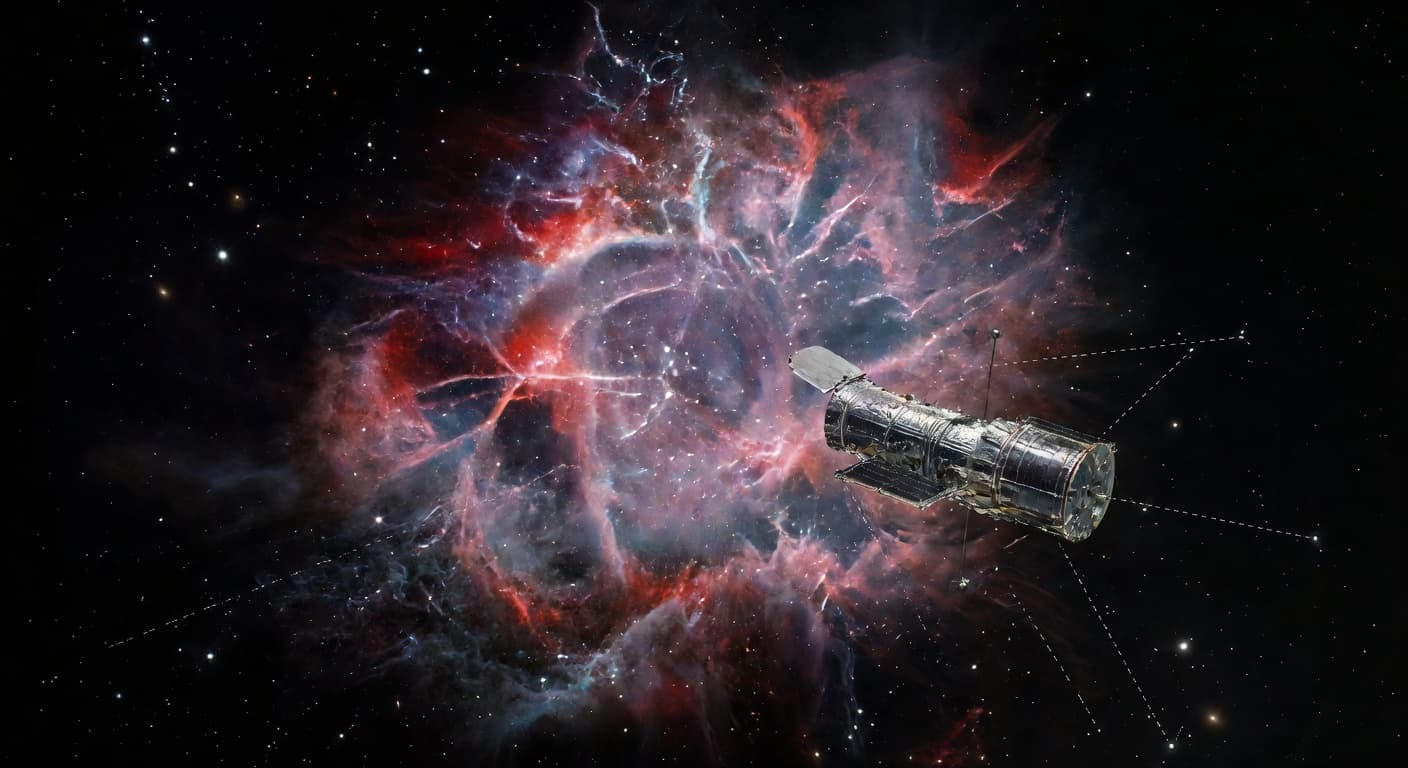
Hubble Tracks 25 Years of Crab Nebula Expansion at 5.5 Million km/h
Hubble Watches the Crab Nebula Expand Over 25 Years
The Hubble Space Telescope has been watching, and on March 23, 2026, astronomers released stunning new observations of one of the most famous objects in the night sky: the Crab Nebula, captured over an extraordinary 25-year baseline.
By comparing images from 1999 with new 2024-2026 observations, researchers have documented the detailed expansion of this 6,500-light-year-distant supernova remnant—material racing outward at 5.5 million kilometers per hour.
The Crab Nebula: A Lab for Violent Astronomy
The Crab Nebula (Messier 1) is the remnant of a supernova explosion observed by Chinese astronomers in 1054 CE. Inside it spins a neutron star—a pulsar—the ultra-dense core left behind after the explosion.
What makes the Crab so scientifically valuable:
- Accessible laboratory: At ~6,500 light-years away, it's close enough for detailed study
- Young remnant: Only ~970 years old, still in active expansion and evolution
- Extreme physics on display: Synchrotron radiation from the pulsar's magnetosphere powers the nebula's glow
- Observable change: Unlike most astronomical objects, the Crab visibly changes on human timescales
What 25 Years of Hubble Data Reveals
Hubble's quarter-century of observations show:
Filamentary Structure Evolution
The nebula's fine wisps of gas—the filaments—change noticeably. Shadows cast by denser material provide 3D insight into the nebula's structure. The expansion isn't uniform; different regions move at slightly different velocities, revealing the complex physics of the remnant.
Synchrotron Radiation Dynamics
The pulsar at the heart pumps enormous energy into the nebula via its rotating magnetic field. This energy powers the bright synchrotron radiation (electrons spiraling in magnetic fields) that makes the Crab so luminous—and visible to Hubble even in visible light.
Expansion Kinematics
Material is expanding at up to 5.5 million km/h (roughly 1,500 km/s). At this rate, material ejected in 1054 has already traveled thousands of light-years—and will continue expanding for millennia.
Why This Matters
The Crab Nebula is more than beautiful—it's a testbed for understanding:
- How supernova remnants evolve
- Pulsar magnetosphere dynamics
- Synchrotron radiation in extreme environments
- The ultimate fate of massive stars
Hubble's long baseline of observations is rare. Most telescopes last 10-20 years; Hubble's 30+ year legacy (launched 1990) makes it uniquely valuable for tracking slow astronomical changes. The new Crab data will drive models of remnant evolution for years.
The James Webb Complement
As Hubble captures visible-light detail, the newer James Webb Space Telescope peers into the infrared, seeing dust and cooler gas invisible to Hubble. Together, they give astronomers an unprecedented multi-wavelength view of one of the cosmos's most dynamic objects.
The Crab Nebula reminds us that the universe is not static—it's a stage of constant, violent, beautiful change.
Source: Phys.org
Comments
Loading comments...