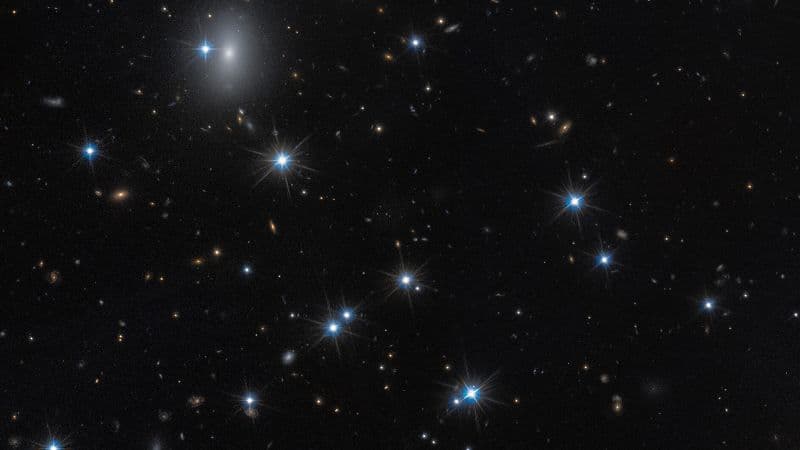
Hubble Discovers Galaxy Made of 99% Dark Matter
A Galaxy of Mystery: 99% Dark Matter
The universe's greatest mystery just got more mysterious. NASA's Hubble Space Telescope has spotted something that shouldn't exist: a galaxy made almost entirely of dark matter.
Dubbed Candidate Dark Galaxy-2 (CDG-2), this discovery challenges everything astronomers thought they knew about how galaxies form. It's not that galaxies can't be dark—we've always known dark matter outweighs visible matter by a factor of five or six to one. But CDG-2 is extreme: 99.9% of its mass is dark matter. Only 0.1% is ordinary matter—stars, gas, dust, all the stuff we can see.
What This Means
Most galaxies follow a predictable pattern: their dark matter halos are 10-15 times heavier than their visible matter. CDG-2 breaks that rule entirely. It's not just a galaxy embedded in a dark matter halo—it's essentially a halo with barely any galaxy inside it.
This challenges leading models of galaxy formation. If dark matter and ordinary matter both arose from the same processes in the early universe, why would some galaxies end up almost entirely dark? The leading theories suggest this shouldn't happen.
A Wrinkle in Our Understanding
CDG-2 might be evidence of something rare: a galaxy that formed in a uniquely violent environment, or one shaped by dark matter dynamics we don't yet understand. It could also be a nearby satellite galaxy stripped of its stars through interactions with a larger galaxy—a "zombie galaxy" of sorts.
Hubble spotted it using gravitational lensing, detecting the gravity signature of the dark matter itself bending light from more distant galaxies. Then spectroscopic observations confirmed the presence of neutral hydrogen gas—proof that there's something there besides dark matter, even if it's not much.
This is exactly the kind of discovery that makes astronomers uncomfortable in the best way. Every answer spawns new questions. And that's where the science gets interesting.
Source: CNN — NASA's Hubble spots galaxy made of 99% dark matter
Comments
Loading comments...