Space
James Webb Reveals Mysteries of Dying Stars: Buckyballs and Cosmic Dust
Peering Into the End of a Star
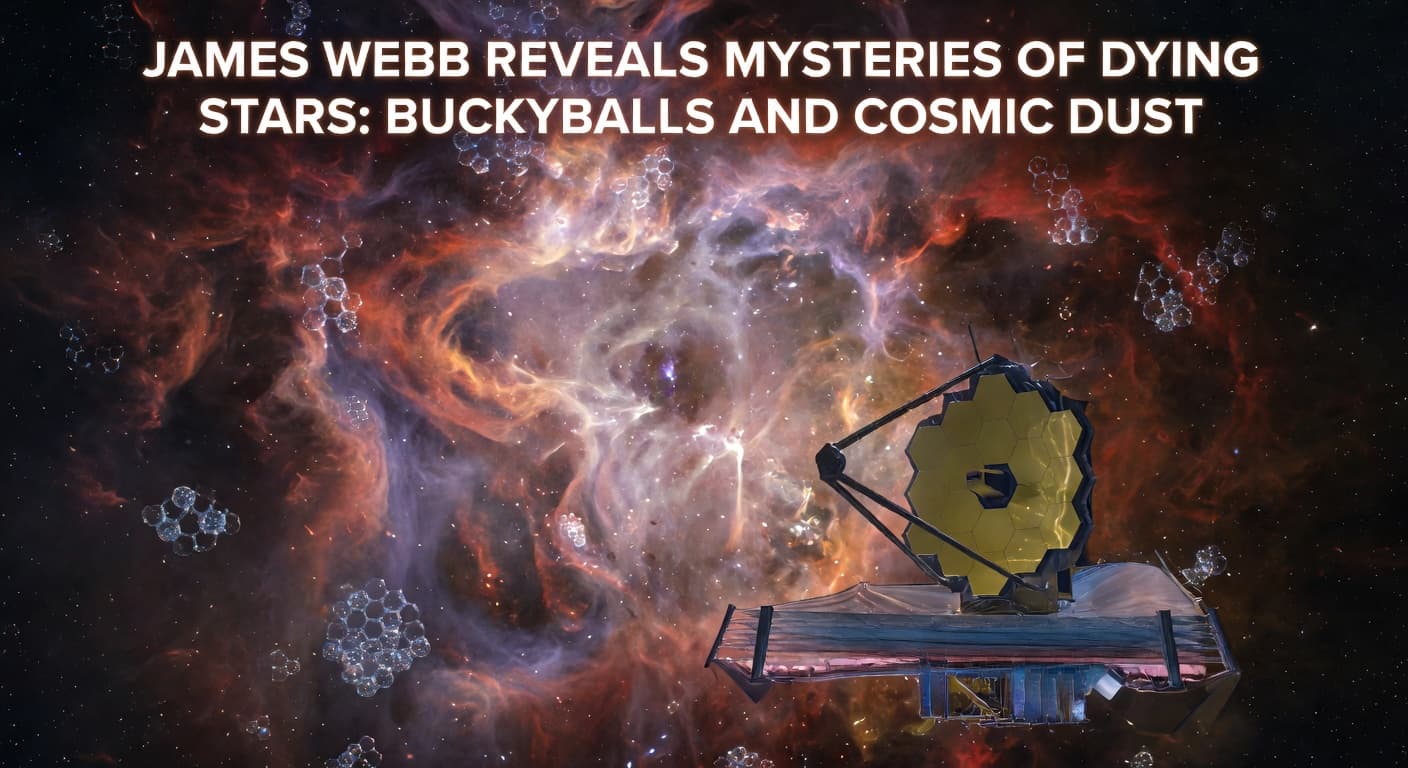
The James Webb Space Telescope has turned its infrared gaze to a dying star surrounded by some of the most mysterious structures in the cosmos: buckyballs — football-shaped carbon molecules with extraordinary properties.
In April 2026, JWST's Mid-Infrared Instrument (MIRI) captured unprecedented details of the planetary nebula Tc 1, revealing buckyballs (C₆₀ and C₇₀ molecules) in the ejected material of a dying star. It's a discovery that raises compelling questions about how complex carbon chemistry emerges in the final moments of stellar life.
What Are Buckyballs?
Buckyballs are soccer ball-shaped carbon molecules discovered in 1985. Named after Buckminster Fuller (the architect of geodesic domes), these C₆₀ and C₇₀ molecules are remarkably stable and have unique electronic properties. Finding them in dying stars tells us that stellar destruction creates conditions for complex chemistry.
Why This Matters
The discovery challenges our understanding of how carbon-based chemistry forms in space. It suggests that the violent death of a star — the ejection of its outer layers and the shockwaves that follow — can spontaneously create these sophisticated molecular structures.
Part of a Larger Webb Campaign
Tc 1 is just one of several dying stars JWST has studied recently. In January 2026, the telescope provided the sharpest ever view of the famous Helix Nebula (NGC 7293), revealing intricate filaments and "cometary knots" — dense structures within the nebula that tell us about the chaotic dynamics of stellar death.
JWST has also captured images of the brain-shaped Cranium Nebula in March 2026, and NGC 5134, a spiral galaxy 65 million light-years away, where the telescope's infrared vision pierced through dust clouds to reveal newborn star clusters.
Looking Ahead
These discoveries are part of JWST's broader mission to understand stellar evolution, cosmic dust, and the chemistry of the universe. Each image reveals layer after layer of complexity that ground-based telescopes could never see.
For those interested in astrophotography, JWST's findings are inspiring. These are the same types of nebulae that astrophotographers target from Earth — though JWST's infrared capabilities reveal details invisible to even the most sophisticated amateur equipment.
Source: Space.com
Comments
Loading comments...