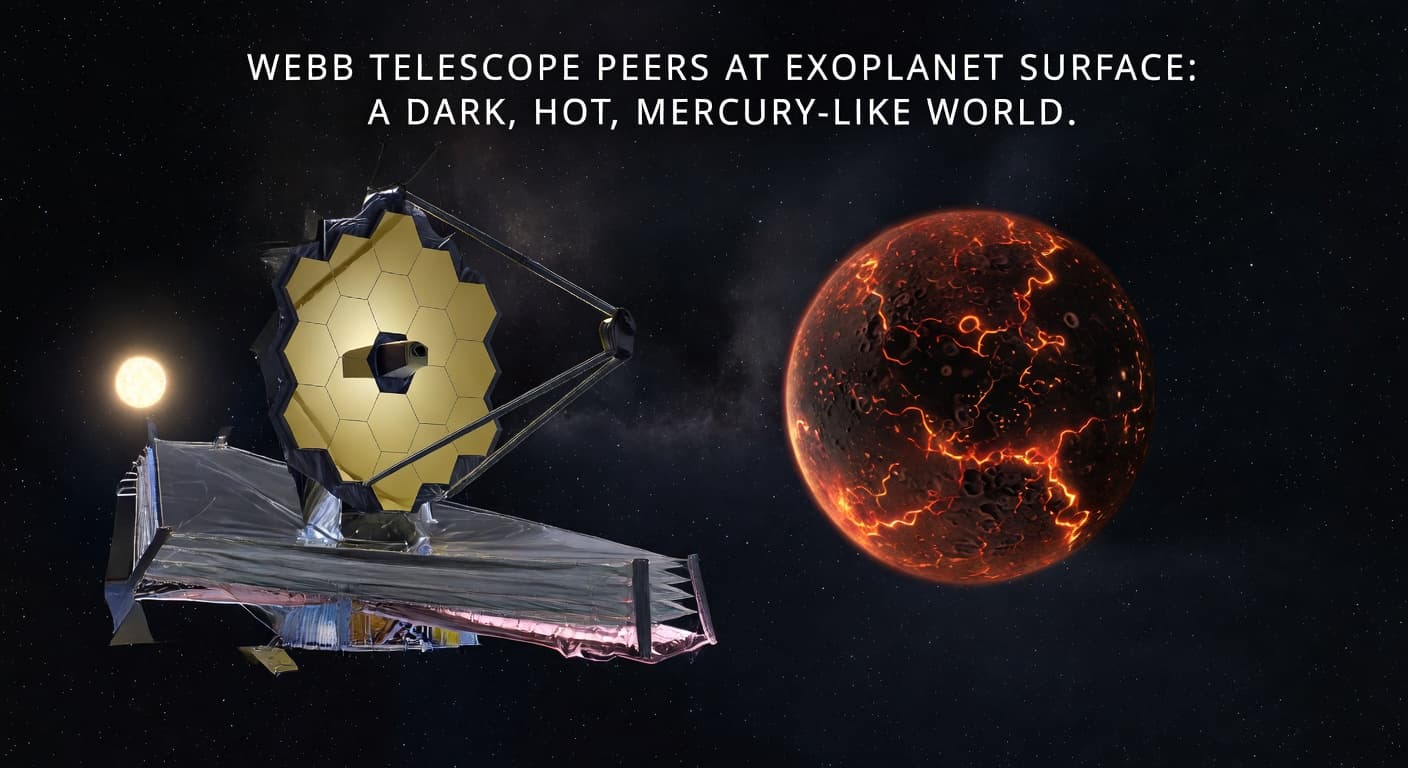
Webb Telescope Peers at Exoplanet Surface: A Dark, Hot, Mercury-Like World
Astronomers have crossed a new frontier in exoplanet science: directly studying the surface of a distant super-Earth using the James Webb Space Telescope.
Direct Surface Observation—A First
In a landmark achievement, the JWST has directly analyzed the surface characteristics of an exoplanet—something once thought impossible from Earth-based observatories. The target: a super-Earth located outside our solar system, revealing itself to be a dark, hot, and barren rocky world.
"We see a dark, hot, barren rock," researchers reported, describing a planet that resembles Mercury more than Earth—a world with no atmosphere, extreme temperatures, and a surface that absorbs rather than reflects light.
Why This Matters
This breakthrough shatters previous assumptions about what we can observe at interstellar distances. The JWST's infrared sensitivity allows it to detect thermal emissions from distant worlds, enabling scientists to characterize surface properties, temperature gradients, and atmospheric composition with unprecedented precision.
Previous exoplanet studies relied on indirect methods: transits (watching stars dim as planets pass), radial velocity (detecting gravitational wobbles), or spectroscopy of atmospheric signatures. Direct surface observation opens an entirely new window on distant worlds.
The Bigger Picture
With thousands of exoplanets confirmed and more discovered weekly, the ability to directly characterize surfaces and atmospheres accelerates the search for potentially habitable worlds. This particular discovery—a sterile, hot super-Earth—tells us what not to look for. But the methodology? That's revolutionary.
The next frontier: can we detect biomarkers in distant atmospheres? Surface water? Signs of habitability? With each JWST observation, we're rewriting the exoplanet rulebook.
Source: Space.com
Comments
Loading comments...