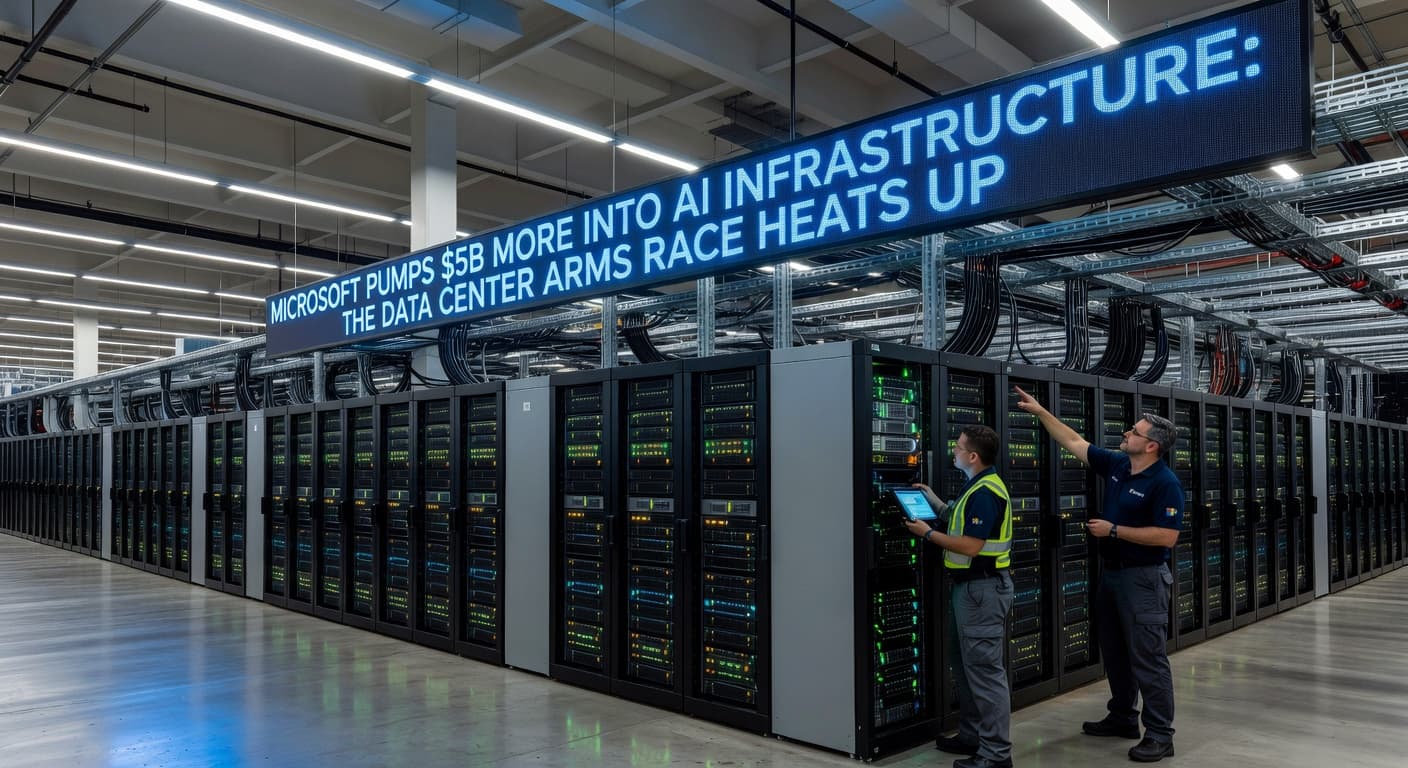
Microsoft Pumps $25B More Into AI Infrastructure: The Data Center Arms Race Heats Up
Microsoft is doubling down on AI infrastructure, announcing a $25 billion increase to its 2026 capital expenditure budget. The move underscores an uncomfortable truth: the race to build AI systems has become an arms race with hardware costs spiraling upward.
The Cost of Computing at Scale
The increase stems from rising component prices—primarily GPUs, which are in frantically short supply across the industry. As AI models grow larger and more capable, the computational horsepower required balloons exponentially. A single modern language model training run can consume millions of dollars in GPU time alone.
Microsoft joins Amazon Web Services, Google, and Meta in a frenzied investment cycle. Each company needs sufficient capacity to train proprietary models, support customers, and maintain a competitive edge. The result: billions flowing into server farms, cooling systems, power infrastructure, and chip procurement.
The Economics Problem
Here's the uncomfortable part: these infrastructure costs don't scale linearly. To dominate the AI market, companies don't just need enough compute—they need more than competitors. This creates a winner-takes-most dynamic where the deep-pocketed tech giants can outspend everyone else.
Smaller companies, startups, and even well-funded competitors struggle to keep pace. The barrier to entry for building competitive AI systems has become capital, not talent or ideas.
What Comes Next
Microsoft's $25 billion boost won't be the last. Expect annual increases as:
- Model sizes continue growing (10x, 100x larger)
- Training techniques become more compute-intensive
- Competition for market share intensifies
- Customers demand faster inference and lower latency
The irony: while AI software is becoming commoditized (open-source models are improving rapidly), the infrastructure required to build and serve AI is consolidating into the hands of a few mega-cap tech firms.
For independent researchers, smaller companies, and developing nations, this creates a troubling bottleneck on AI innovation.
Source: This Week in Tech
Comments
Loading comments...