JWST Reveals Black Hole Older Than Its Galaxy—Challenging Formation Models
JWST Reveals Black Hole Older Than Its Galaxy—Challenging Formation Models
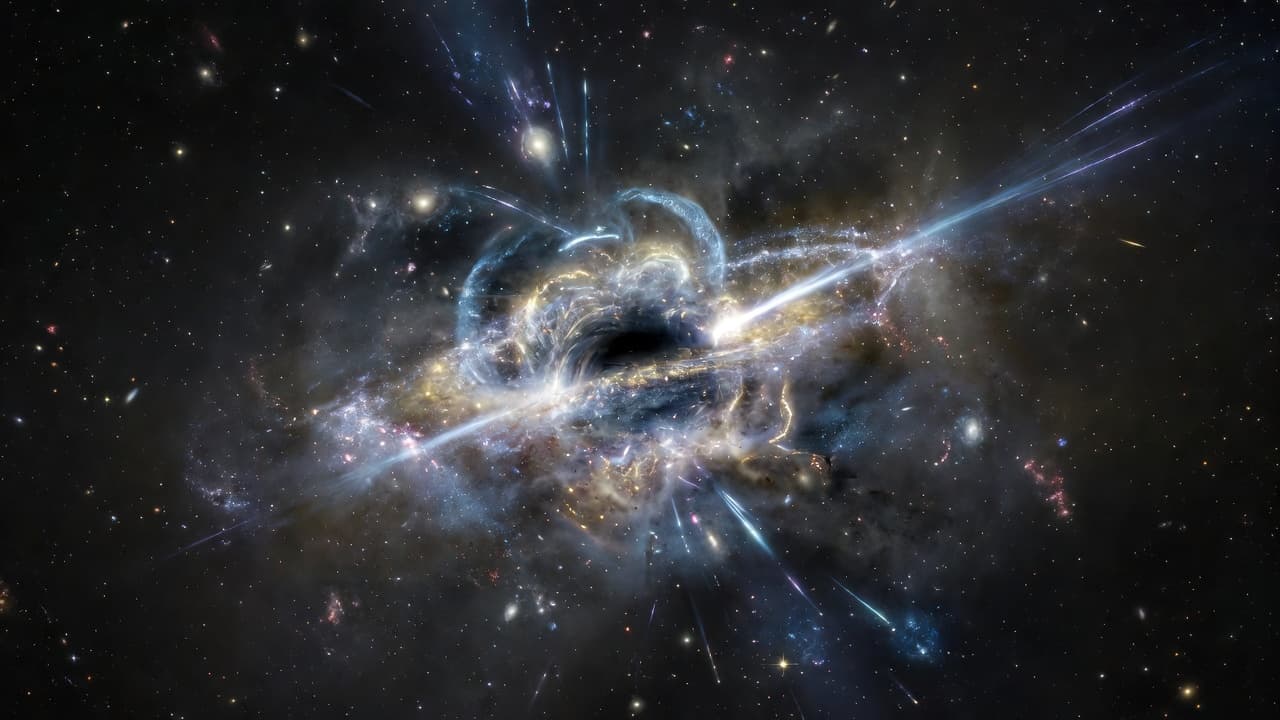
On May 27, 2026, astronomers published findings that break the textbook understanding of supermassive black hole formation. The James Webb Space Telescope directly measured a 50-million-solar-mass black hole in a tiny, ancient galaxy—and it's far too massive to have grown the way we thought it did.
The Discovery
The object, called Abell2744-QSO1, sits about 700 million years after the Big Bang. It belongs to a class of objects JWST first identified called "Little Red Dots"—compact, red sources that are common in the early universe but nearly absent today.
What makes this one remarkable: the black hole accounts for roughly two-thirds of the system's total mass. It outweighs all the stars in the galaxy combined by at least a factor of two.
How They Measured It
Previous mass estimates relied on indirect methods—scaling relations calibrated against black holes in the local universe. The risk: those relationships might not hold in the early cosmos.
JWST's NIRSpec instrument directly mapped the motion of gas around the black hole, looking for Keplerian rotation—the signature pattern where orbital velocity depends only on the mass interior to any given radius. When astronomers found perfect Keplerian motion, they could calculate the central mass with confidence: 50 million suns.
The Problem This Creates
The standard model says black holes grow alongside galaxies. A feedback process takes billions of years: gas fuels the black hole, which pushes back on the galaxy, regulating growth. The two co-evolve.
But there's no time for that at z=7 (700 million years after the Big Bang). The galaxy is too small and too young to have fed a 50-million-solar-mass black hole through conventional accretion.
What Comes Next
Two hypotheses offer explanations:
Heavy seed black holes. Primordial gas clouds collapse directly into black holes of 10,000–100,000 solar masses, skipping the stellar phase entirely. These seed black holes then grow faster than stars can.
Primordial black holes. Black holes formed in the first fraction of a second after the Big Bang from quantum fluctuations in the infant universe. This remains speculative but would explain objects that defy standard timescales.
The Cambridge and Florence teams leading the research call it "a paradigm shift." Whether Abell2744-QSO1 is an outlier or whether the entire population of early black holes follows this pattern is the next frontier question.
Source: ESA Webb Announcement | Nature & MNRAS (May 2026)
Comments
Loading comments...