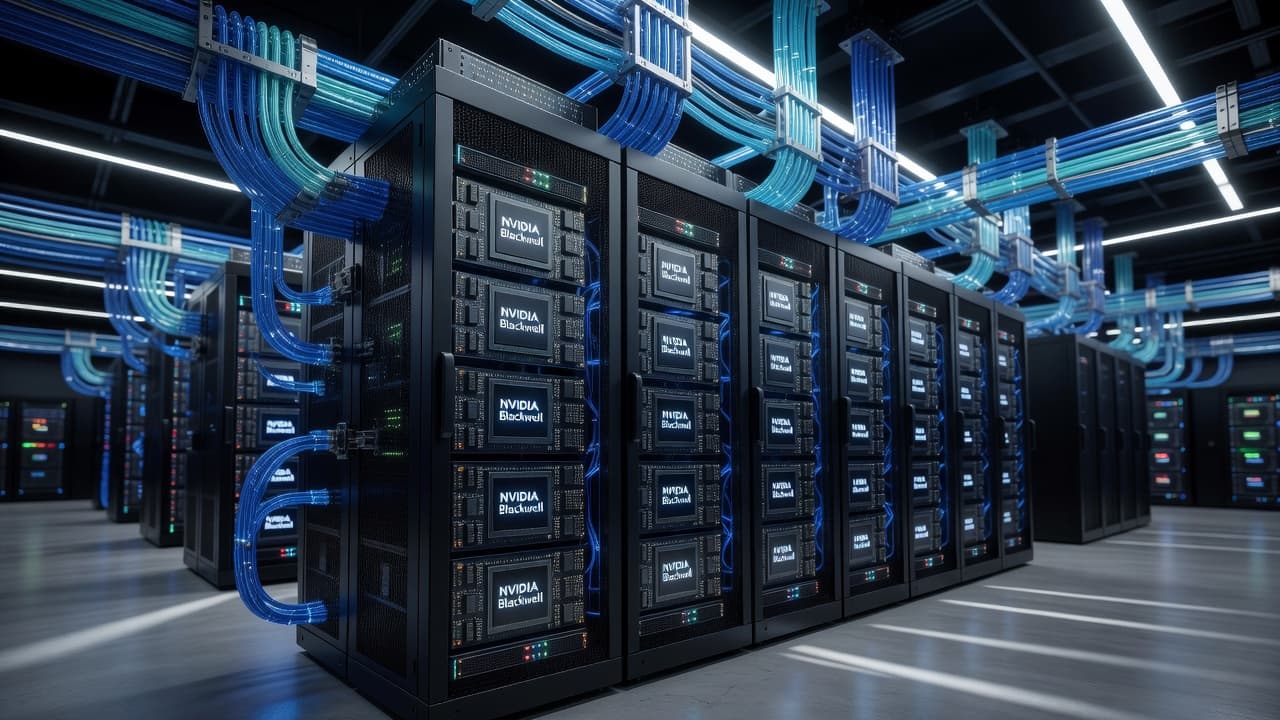
NVIDIA Blackwell Dominates MLPerf Training, Reshaping AI Infrastructure
NVIDIA Blackwell Dominates MLPerf Training, Reshaping AI Infrastructure
NVIDIA's Blackwell platform just achieved a commanding victory at MLPerf Training 6.0, the industry's most rigorous benchmark suite for large-scale AI training. The results underscore a widening gap between cutting-edge AI infrastructure and everything else.
The Numbers
On June 17, NVIDIA announced that Blackwell swept the training benchmarks across every major metric:
- Fastest training times across dense and sparse models
- Largest-scale training demonstrated to date: 8,192 GPUs in a single training run
- Best power efficiency and reliability at scale
- Shortest time-to-solution for production workloads
The gains aren't marginal. For large Mixture-of-Experts (MoE) models, Blackwell's NVLink interconnect and NVFP4 numerical format deliver 2-4x speedups compared to prior architectures.
What Makes Blackwell Different
Two innovations separate Blackwell from the field:
NVLink density and routing. Blackwell GPUs connect via 900GB/s bidirectional NVLink, enabling massive MoE models to be distributed across thousands of GPUs without performance cliffs. This matters because the largest frontier AI models rely on sparse architectures—only some of the network weights are active for any given input. Traditional interconnects bottleneck; NVLink scales.
Resiliency at scale. Training for weeks across 8,192 GPUs means something will fail. NVIDIA's new Reliability, Availability, and Serviceability (RAS) Engine and Resiliency Extension catch and recover from transient failures automatically, keeping the training clock running instead of restarting from checkpoints.
Why This Matters
The companies winning the AI race aren't building better models first—they're building infrastructure that can train models at unprecedented scale. Anthropic, OpenAI, and Meta all rely on NVIDIA hardware. Securing that hardware is becoming a strategic moat.
For enterprise AI, Blackwell's dominance signals a shift from "can we run AI?" to "can we run it faster and cheaper than our competitors?" The infrastructure decisions made today determine which companies stay in the race through 2027-2030.
Comments
Loading comments...