JWST Spots the Most Distant Jellyfish Galaxy Yet—And It Challenges What We Know About the Early Universe
Sometimes the most interesting discoveries are the ones that break our assumptions.
Researchers at the University of Waterloo have identified the farthest jellyfish galaxy ever observed using JWST. It sits at redshift z=1.156—light that's been traveling for 8.5 billion years to reach us. And what they found is making astronomers reconsider the harsh environments of the early universe.
What's a Jellyfish Galaxy?
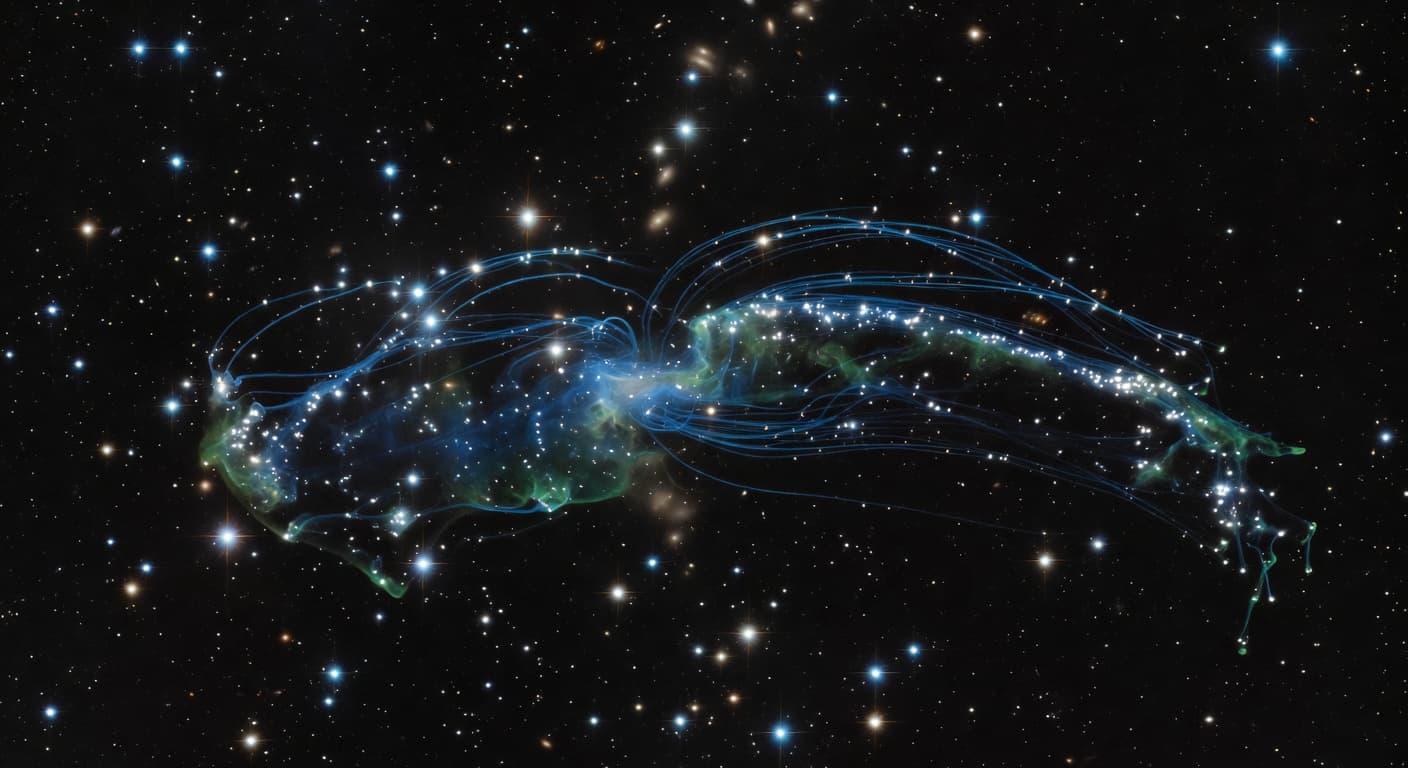
The name is literal. Jellyfish galaxies have long, flowing streams of gas that stretch out behind them like tentacles. The physics is brutal: these galaxies race through dense galaxy clusters filled with scorching hot gas. As they plow forward, that surrounding gas pushes against them like a powerful headwind, sweeping their own gas backward in trailing strands. Astronomers call it ram-pressure stripping.
It's violent. It's effective. And until now, we thought it was rare in the early universe.
The Surprise
This newly discovered jellyfish galaxy has something remarkable: bright blue clumps scattered along its trailing streams. These are extremely young stars—stars that formed outside the main galaxy body, within the gas that was stripped away. That's the signature of active star formation during ram-pressure stripping.
But here's the kicker: cluster environments 8.5 billion years ago were supposed to still be assembling. Ram-pressure stripping should have been rare. The fact that we're seeing it so clearly, so far back in cosmic history, suggests something different.
"The cluster environments were already harsh enough to strip galaxies, and the galaxy clusters may have strongly altered galaxy properties earlier than expected," said Dr. Ian Roberts, the lead researcher. "This might help explain all those 'dead' galaxies we see in clusters today."
What This Means
If early galaxy clusters were harsher than we thought—brutal enough to strip gas and halt star formation billions of years ago—then our models of galaxy evolution are incomplete. It rewrites the story of how galaxies evolved from the early universe to today.
JWST has already applied for additional observing time to study this galaxy in greater detail. And you can bet other astronomers are searching the JWST archives for similar candidates.
The early universe keeps surprising us. That's why we keep looking.
Comments
Loading comments...