Space
James Webb's 'Little Red Dots' May Be Black Hole Stars, X-ray Data Suggests
Are JWST's Mysterious Red Dots Actually Black Hole Stars?
When the James Webb Space Telescope began observations of the early universe, it discovered something unexpected: tiny, extremely luminous objects with distinctly red colors. These "little red dots" have puzzled astronomers for months. Now, new X-ray data suggests a tantalizing explanation: they might be "black hole stars"—exotic theoretical objects never directly observed before.
The Little Red Dots Mystery
Early JWST observations revealed these objects appearing surprisingly bright and compact in the infrared spectrum. Their extreme luminosity contradicted what we know about early galaxy formation. Traditional models suggest galaxies take time to build up mass and form bright active cores, yet these dots appeared fully formed just 300-400 million years after the Big Bang.
Several competing theories emerged: perhaps they were unusual quasars, massive black holes, primordial black holes, or something entirely new.
X-ray Evidence for Black Hole Stars
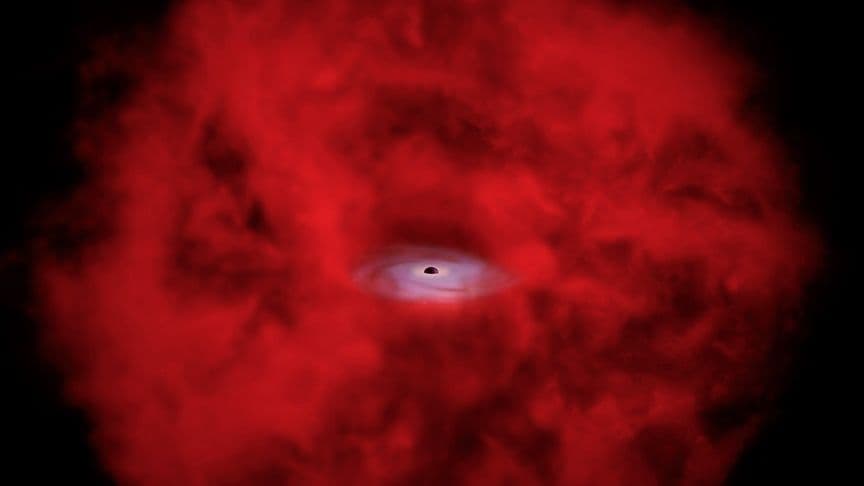
Recent X-ray observations from space telescopes detected emission from one of these objects—a crucial clue. The X-ray signature is consistent with matter falling into a supermassive black hole, but with an unusual twist. The data suggests these objects might combine a black hole with a massive, dense stellar envelope—a configuration physicists have theoretically explored but never confirmed observationally.
In this model, an extremely dense star made of degenerate matter surrounds a central black hole. The system would be unlike anything in our local universe, existing only under the extreme conditions of the early cosmos.
Why This Matters
If confirmed, this would represent a new class of celestial objects and fundamentally expand our understanding of what's possible in the early universe. It would also solve the "too luminous, too early" problem—these objects would have unique power mechanisms distinct from traditional AGN.
The convergence of JWST's infrared observations with X-ray data exemplifies modern astronomy's power. No single wavelength tells the complete story; combining multiple telescopes provides insights impossible with just one perspective.
The Road Ahead
This discovery is still preliminary. More X-ray observations and theoretical modeling are needed to confirm whether black hole stars actually exist and whether they explain the little red dots. If true, we're witnessing early evidence for exotic physics that challenges our cosmic models.
Source: Space.com - James Webb's Strange Little Red Dots May Be Black Hole Stars
Comments
Loading comments...