AI
Scientist Questions Microsoft's Quantum Computing Claims in Nature
Quantum Skepticism: Scientist Challenges Microsoft's Major Breakthrough
Microsoft's high-profile quantum computing claims have drawn serious criticism from an expert in the field. Dr Henry Legg, a Cambridge-based physicist, published a detailed critique in the prestigious journal Nature, raising significant questions about the company's assertions of a major quantum computing advance.
The Dispute: Majorana Particles and Software Reliability
Microsoft has invested billions in quantum computing, claiming a landmark breakthrough: the creation of a theoretical quasi-particle called Majorana, which underpins the company's entire quantum architecture.
Legg's critique focuses on two main issues:
- Software validity: The analysis tool Microsoft used to verify its results contains coding errors and lacks sufficient accuracy
- Unproven claims: Microsoft still hasn't demonstrated that it actually created a Majorana particle, despite claims to the contrary
A Swiss Watch That Doesn't Tick
Legg drew a vivid metaphor for his findings: "Last year Microsoft claimed they had built the equivalent of a precision Swiss watch. However when I opened the case to examine the mechanism, I found what looked like a chaotic jumble of mismatched parts."
Microsoft stood by its research, releasing a response in Nature. The company argued that the software Legg referenced doesn't interpret measurements in the way he suggested, and noted it's sharing all data with the U.S. defense agency DARPA for independent review.
The Transparency Question
A persistent criticism in Legg's paper: Microsoft isn't sharing enough data with the scientific community for independent verification. While peer review and reproducibility are cornerstones of scientific progress, Microsoft claims some data is too commercially sensitive to publish publicly.
Context: Quantum Computing Hype Cycle
Quantum computing represents a genuine paradigm shift — machines that work on quantum principles could theoretically solve problems far beyond even the world's most powerful supercomputers. It's a multi-billion dollar industry already.
But current quantum machines remain extremely fragile. The slightest interference — a vibration, a temperature change — can corrupt results. The race for reliable, scalable quantum systems is intense, and claims are understandably scrutinized.
Microsoft's Latest Move
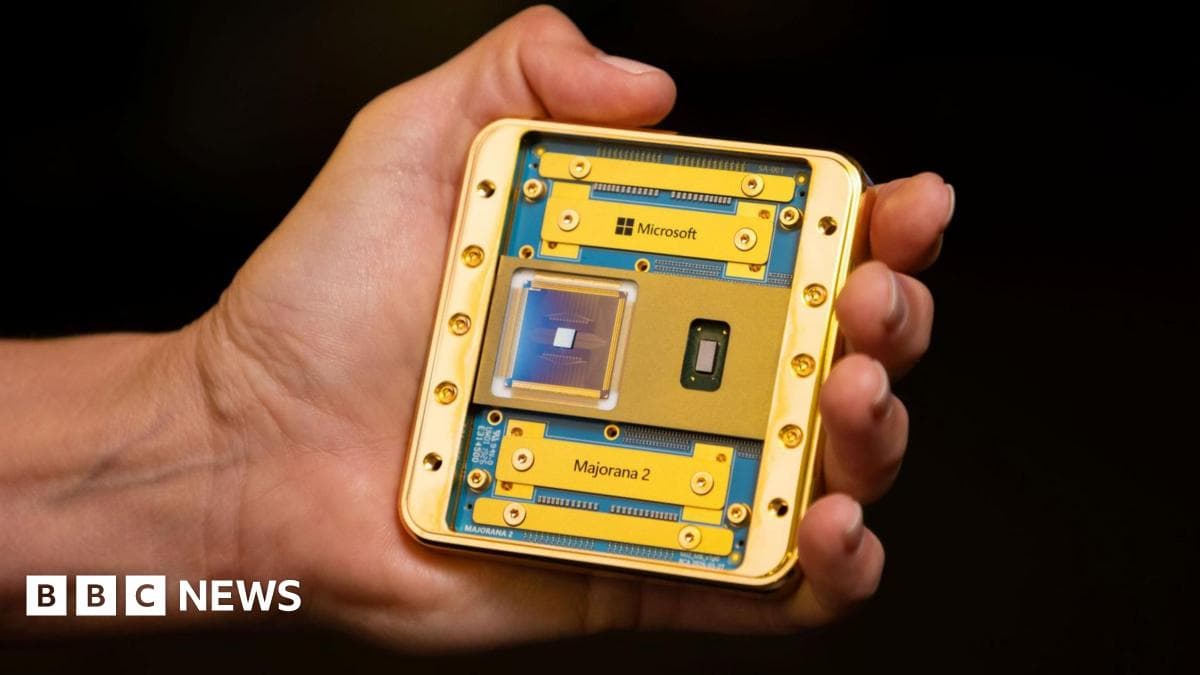
Since the 2025 research Legg critiques, Microsoft has released a second-generation Majorana chip, claiming it's 1,000 times more reliable than the previous version. However, the fundamental question of whether the approach actually works remains contested.
Source: BBC News
Comments
Loading comments...