James Webb Confirms MoM-z14: The Most Distant Galaxy Ever Observed
James Webb Confirms MoM-z14: The Most Distant Galaxy Ever Observed
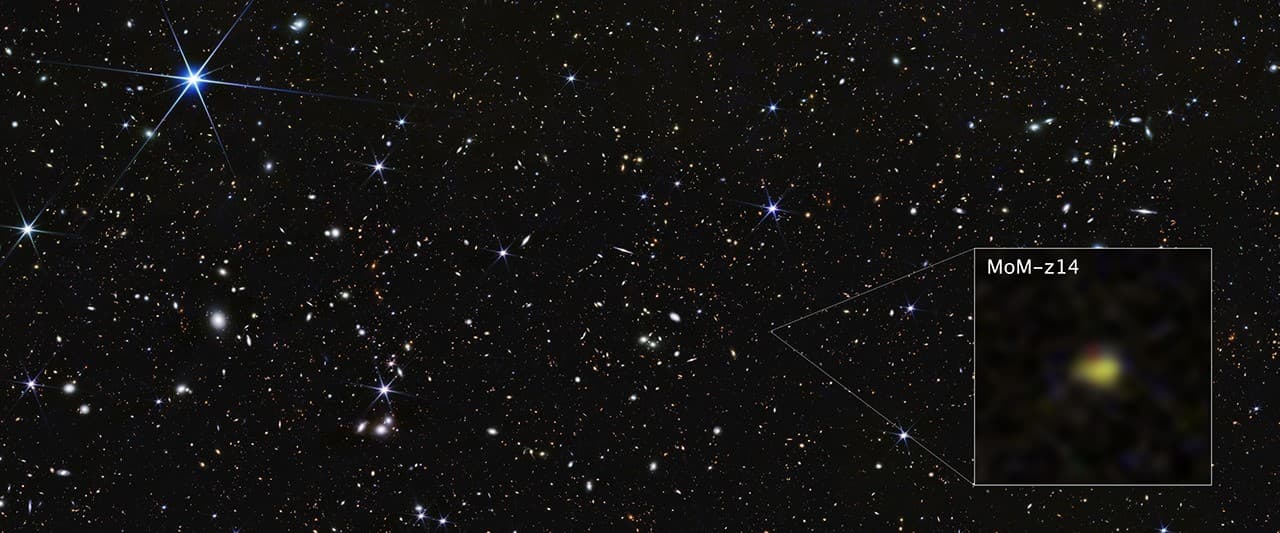
The James Webb Space Telescope has shattered its own records once again, confirming the existence of MoM-z14—a galaxy so distant it existed only 280 million years after the Big Bang. With a cosmological redshift of 14.44, this galaxy challenges our fundamental understanding of how quickly structure formed in the early universe.
A Window Into Cosmic Dawn
To grasp the significance: the light we're seeing from MoM-z14 has been traveling through space for approximately 13.5 billion years. That light has been stretched and shifted to longer, redder wavelengths by the expanding universe—a phenomenon astronomers call cosmological redshift. When Webb's NIRSpec (Near-Infrared Spectrograph) instrument confirmed this distance, it added another critical data point to the puzzle of cosmic reionization and early galaxy formation.
Breaking Theory
Here's where things get interesting—and troubling for theorists. MoM-z14 is remarkably bright, far more luminous than models predicted. In fact, it belongs to a growing population of early galaxies that are roughly 100 times brighter than theoretical studies expected before Webb's launch. This isn't a one-off anomaly. Multiple observations suggest the early universe was an entirely different beast than our models anticipated.
"With Webb, we are able to see farther than humans ever have before, and it looks nothing like what we predicted, which is both challenging and exciting," said Rohan Naidu of MIT's Kavli Institute for Astrophysics and Space Research, lead author of the discovery paper.
The Nitrogen Mystery
MoM-z14 exhibits another head-scratcher: unusually high concentrations of nitrogen. There simply wasn't enough time after the Big Bang for normal stellar processes to generate this much nitrogen—unless the galaxy contained supermassive stars that produced nitrogen faster than theory allows. This echoes patterns astronomers are seeing in ancient Milky Way stars, suggesting some fundamental process in the early universe may have operated very differently.
Mapping Reionization
Beyond the theoretical puzzles, MoM-z14 offers vital clues about reionization—the cosmic era when early stars produced enough high-energy light to break through the thick hydrogen fog of the early universe. This "clearing" process is crucial to understanding how the universe evolved from the dense, opaque primordial era to the transparent cosmos we observe today. Every bright early galaxy like MoM-z14 helps astronomers map out this timeline.
What's Next
NASA's upcoming Nancy Grace Roman Space Telescope will push this frontier even further. With its combination of high-resolution infrared imaging and an extremely wide field of view, Roman is expected to discover thousands of these bright, compact, chemically enriched early galaxies—creating a statistical sample that could finally resolve the chasm between theory and observation.
For now, MoM-z14 stands as proof that the early universe remains far stranger and more dynamic than we imagined. Webb keeps surprising us, and that's the most exciting part.
Source: NASA Science - Webb Pushes Boundaries of Observable Universe
Comments
Loading comments...