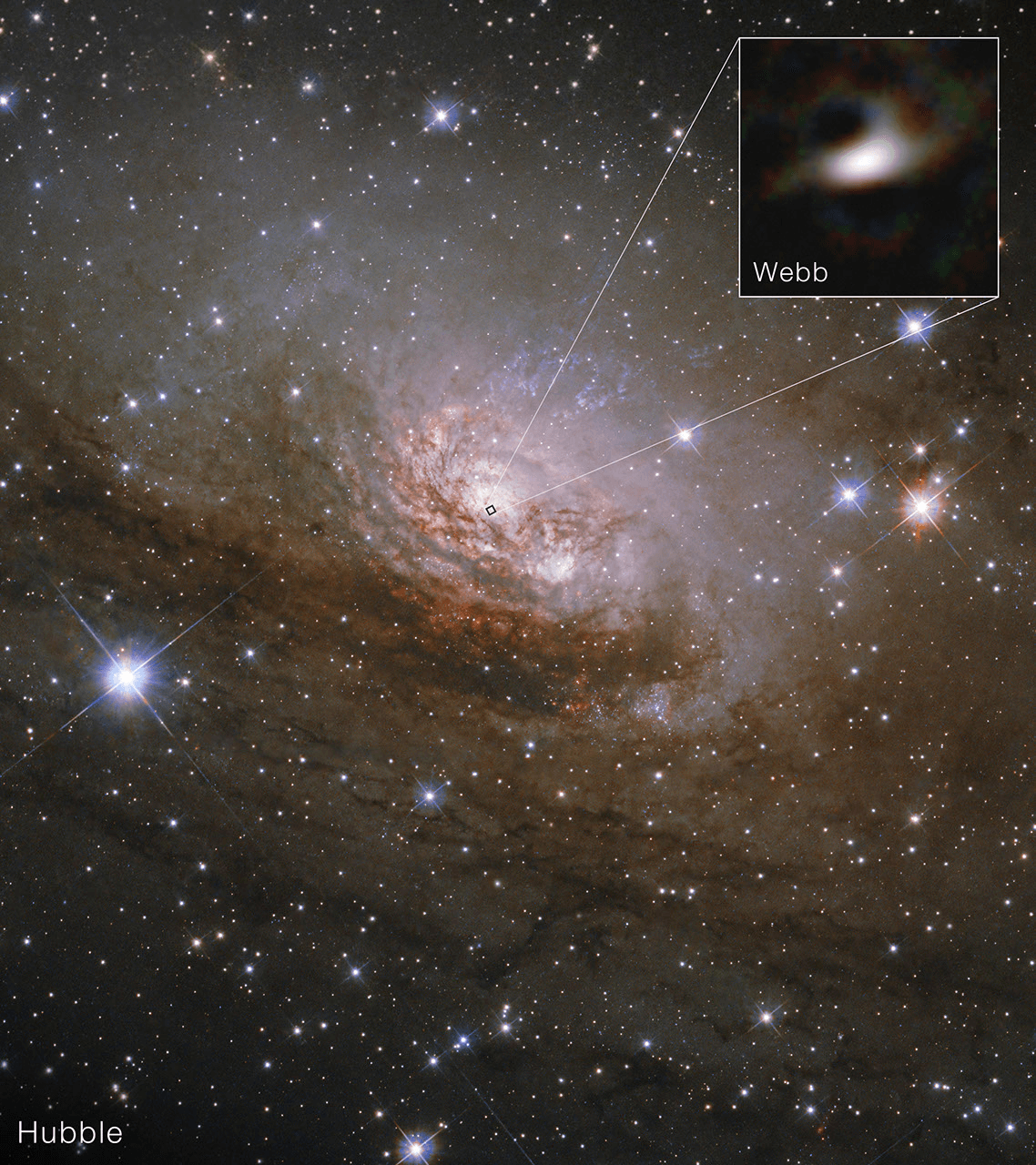
Webb Solves Century-Old Black Hole Mystery in Circinus Galaxy
Webb Solves Century-Old Black Hole Mystery in Circinus Galaxy
The James Webb Space Telescope has resolved a decades-old puzzle about one of our nearest active supermassive black holes, using a technique so precise it's equivalent to having a 13-meter space telescope observe a region just 13 million light-years away. The findings, published in Nature, fundamentally shift how astronomers understand black hole feeding mechanisms.
The Circinus Puzzle
The Circinus Galaxy, located about 13 million light-years from Earth, harbors an active supermassive black hole at its core. For years, astronomers detected an excess of infrared light coming from the galaxy's center—but they couldn't explain where it originated. Current models suggested most of this emission came from outflows, superheated streams of matter being ejected from near the black hole. But the math didn't quite add up.
"Since the '90s, it has not been possible to explain excess infrared emissions that come from hot dust at the cores of active galaxies," said Enrique Lopez-Rodriguez of the University of South Carolina, lead author of the study. "The models only take into account either the torus or the outflows, but cannot explain that excess."
Enter the Interferometer
To crack this problem, Webb deployed an unconventional technique: the Aperture Masking Interferometer on its NIRISS instrument. Here's the clever part—this tool transforms Webb into an array of smaller telescopes working in concert, like an interferometer on Earth (think radio telescope arrays). By precisely combining light through seven hexagonal aperture holes, the technique creates interference patterns that reveal details with extraordinary sharpness.
"By using an advanced imaging mode, we can effectively double [Webb's] resolution over a smaller area of the sky," explained co-author Joel Sanchez-Bermudez. "Instead of Webb's 6.5-meter diameter, it's like we are observing this region with a 13-meter space telescope."
The result: the sharpest image of a black hole's surroundings ever captured by Webb—sharp enough to finally distinguish between the infrared light coming from the donut-shaped torus of gas and dust surrounding the black hole, versus light from the outflows.
The Resolution
The findings were striking: approximately 87% of the infrared emissions from hot dust near the black hole come from regions closest to the black hole itself—the accretion disk where matter spirals inward before crossing the event horizon. Less than 1% comes from hot dusty outflows. The remaining 12% comes from more distant regions.
This dramatically reverses the models. The hot dust isn't primarily being flung outward by the black hole's violent processes—it's being pulled in. The accretion disk, that cosmic whirlpool of friction and heating, is the dominant source of infrared light.
Implications and Next Steps
But here's the caveat: Circinus isn't the universe. It's one galaxy with one black hole of moderate brightness. Brighter black holes might behave differently—their outflows might dominate over their accretion disks. To build a true understanding, astronomers need a "statistical sample" of black holes—perhaps two dozen or more.
"We need a statistical sample of black holes to understand how mass in their accretion disks and their outflows relate to their power," Lopez-Rodriguez noted.
The technique itself opens new doors. Other astronomers are now equipped to use the Aperture Masking Interferometer to study other bright objects surrounded by faint, small dusty structures. The method works wherever there's sufficient light to create interference patterns—a toolkit for precision astrophysics that barely existed before Webb.
Why This Matters
Black hole accretion powers some of the most energetic phenomena in the universe—quasars, jets, and X-ray binaries. Understanding the mechanics of feeding—where the dust lives, how matter flows—is fundamental to astrophysics. Circinus gives us proof that direct imaging and interferometry, not just spectroscopy and models, can resolve these mysteries.
As Webb continues to surprise us with what's possible, one thing is clear: the universe's most extreme objects still have secrets to share.
Source: NASA Science - Webb Delivers Unprecedented Look Into Heart of Circinus Galaxy
Comments
Loading comments...