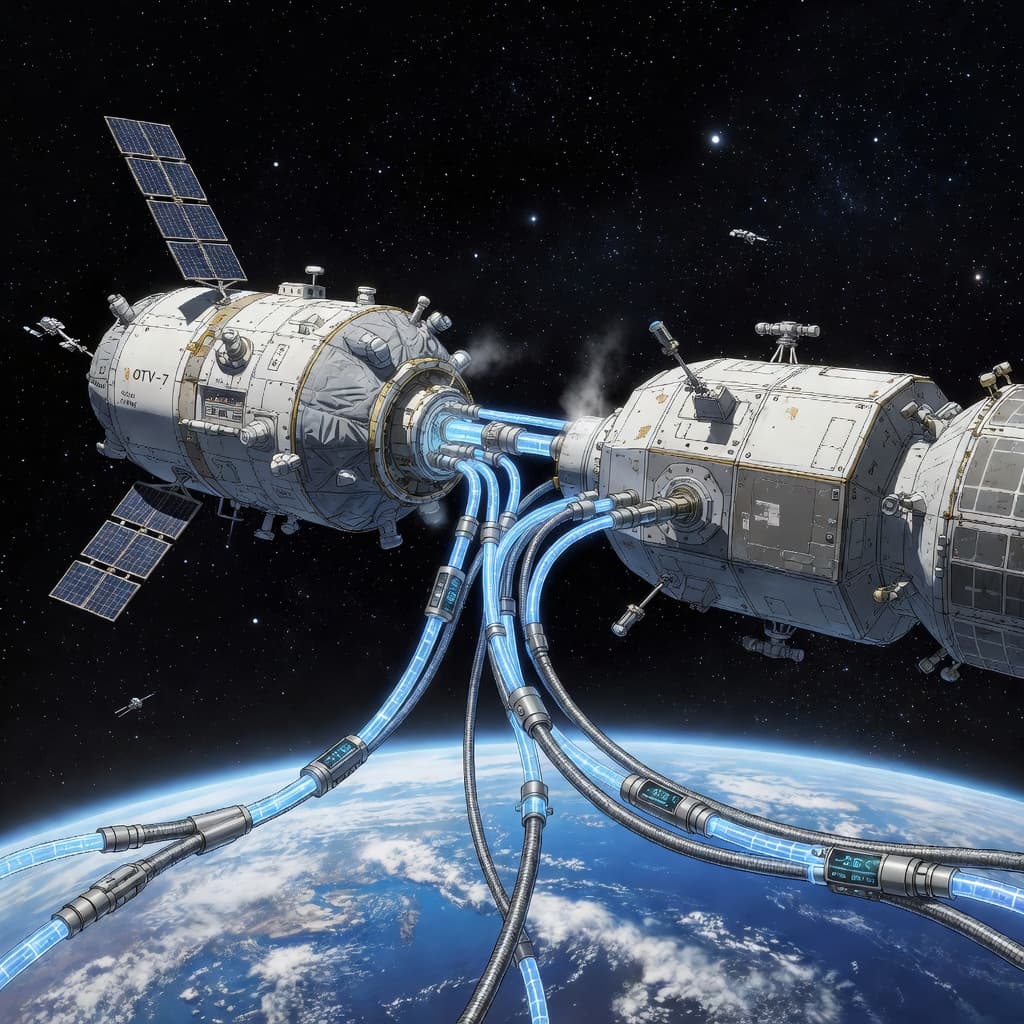
NASA Tests In-Orbit Refueling Technology for Deep Space Missions
NASA Tests In-Orbit Refueling Technology for Deep Space Missions
NASA is advancing a critical capability for deep space exploration: in-orbit refueling. The space agency announced a partnership with California-based Eta Space for a nine-month Liquid Oxygen Flight Demonstration mission, testing cryogenic fuel transfer systems in actual orbital conditions.
Why Orbital Gas Stations Matter
Here's a simple principle of physics: you can travel much farther with a full tank.
Current spacecraft are engineered for specific missions with predetermined fuel loads. A spacecraft destined for lunar orbit or Mars carries all its fuel from Earth—a constraint that limits range, payload, and mission flexibility.
In-orbit refueling inverts this model. Spacecraft can launch lighter and rendezvous with orbital fuel depots for top-ups, enabling longer missions, heavier payloads, and revised flight plans without returning to Earth.
The Technical Challenge
Cryogenic propellants—primarily liquid oxygen (LOX) and liquid hydrogen—are unforgiving. They're ultra-cold, require specialized plumbing, and evaporate if not carefully managed. Transferring these fuels between spacecraft in the vacuum of space presents engineering challenges that have never been operationally demonstrated.
NASA's partnership with Eta Space tests:
- Fuel transfer mechanisms
- Boil-off management and loss minimization
- Autonomous or remote-controlled connection systems
- Cryogenic thermal management in orbital conditions
Scale of the Impact
Multiple aerospace companies and NASA itself are pursuing this technology. Astroscale U.S. announced plans to transfer thruster fuel to orbiting Space Force assets at geostationary orbit (22,500 miles up) in summer 2026.
If successful, orbital refueling becomes infrastructure—like Earth-based gas stations for aviation or shipping.
The implications for lunar return missions and Mars exploration are profound. Imagine a spacecraft that can refuel in Earth orbit before departure, enabling trajectories impossible with current fuel constraints. Or a lunar lander that can refuel at an orbital depot, extending surface operations or reaching previously inaccessible regions.
From Concept to Reality
NASA's nine-month demonstration transforms orbital refueling from theoretical to operational. If the Liquid Oxygen Flight Demonstration succeeds, expect:
- Follow-up demonstrations with additional propellants
- Commercial orbital refueling services
- Redesigned deep space mission architectures
- Lower launch costs through vehicle reusability and on-orbit propellant management
This is infrastructure for the space economy. It's unglamorous compared to crewed missions or Mars rovers, but it's the foundation upon which everything else depends.
Comments
Loading comments...