Space
2026: A Landmark Year for Space Exploration — Artemis, Starship, and New Telescopes
2026: The Year Space Exploration Gets Serious
After 2025's solid progress, 2026 is shaping up to be a landmark year for humanity's venture beyond Earth. Whether it's boots (nearly) returning to the moon or new eyes peering into the cosmos, 2026 promises breakthroughs that redefine what's possible in space.
Artemis 2: Humans Return to Deep Space
NASA's Artemis 2 will send four astronauts—Reid Wiseman, Victor Glover, Christina Koch, and Canadian Jeremy Hansen—on a 10-day journey around the moon. This marks humanity's first crewed mission beyond low Earth orbit since Apollo 17 in 1972.
Aboard the Orion spacecraft atop the Space Launch System megarocket, the crew will test life-support systems, navigation, and communications in the harsh environment of deep space. The mission targets launch no earlier than February 5, 2026, with a window extending into April.
SpaceX's Starship: Reaching Orbit and Beyond
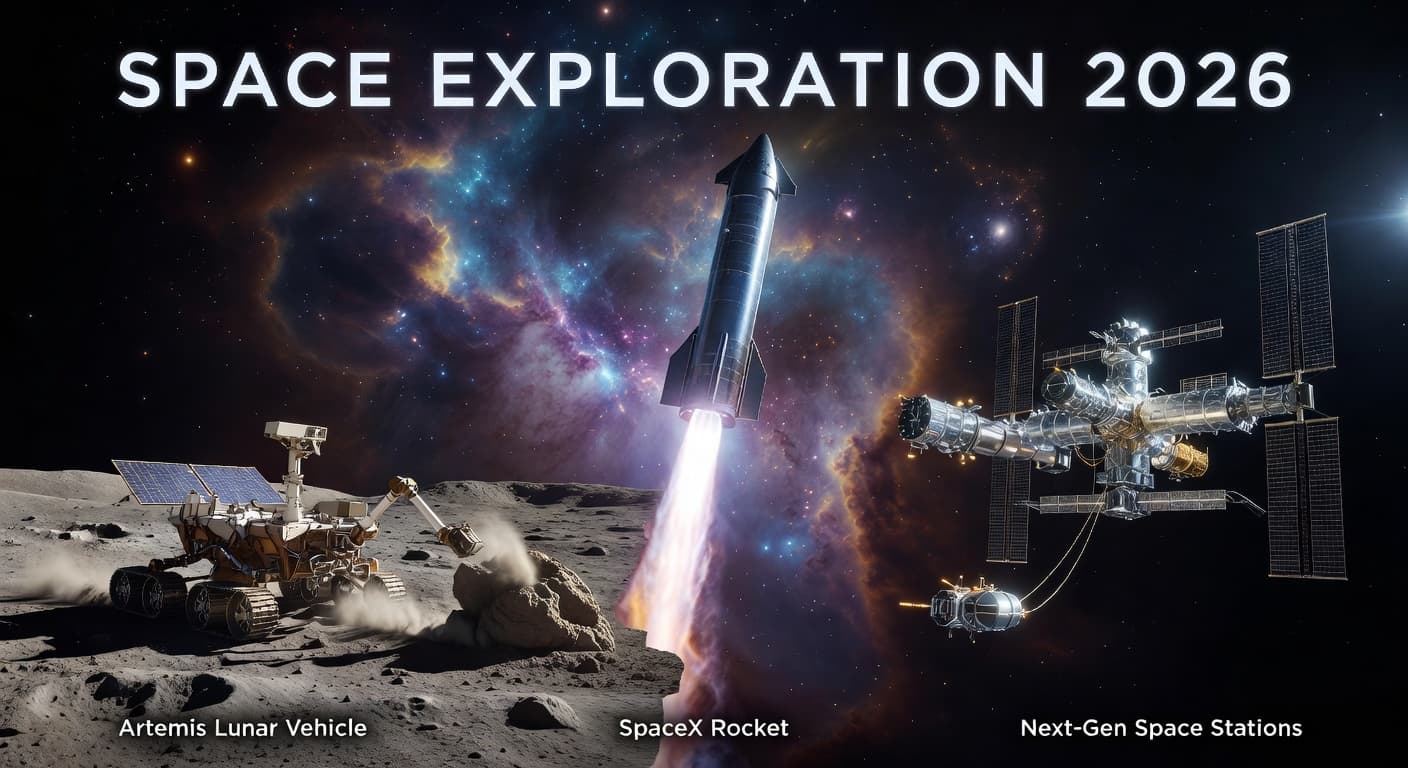
SpaceX aims to make 2026 a breakout year for Starship, with goals including the first orbital flight and a critical demonstration of in-orbit cryogenic propellant transfer—a capability essential for future Mars missions. While Elon Musk has suggested a Mars launch attempt might happen in 2026, he's been candid about the odds being "roughly 50–50."
What's more likely and more important: achieving rapid reusability of both the Super Heavy booster and Ship upper stage. Even without an interplanetary launch, these milestones would represent a pivotal step toward sustainable deep-space exploration.
Nancy Grace Roman: New Telescope, New Universe
NASA's Nancy Grace Roman Space Telescope is expected to launch in fall 2026 (with some margin extending into 2027). Roman features a field of view approximately 100 times larger than Hubble's, making it one of the most powerful space observatories ever built.
Roman's primary science goals include mapping dark matter, studying dark energy, and discovering thousands of exoplanets through gravitational microlensing—in which a massive foreground object acts like a cosmic lens, magnifying background starlight.
The Lunar Race Intensifies
Blue Origin's Mark 1 lunar lander will attempt a robotic demonstration mission to the moon's south pole in early 2026. Standing 26 feet tall and launched atop the company's New Glenn rocket, it will be the largest commercial lunar cargo lander ever built.
China's Chang'e 7 mission, launching mid-to-late 2026, will also target the lunar south pole with a lander, rover, and hopping probe—all searching for water ice in permanently shadowed craters.
Other Notable 2026 Milestones
- Haven-1: Vast Space's first privately developed stand-alone space station launches no earlier than May 2026
- Neutron Debut: Rocket Lab's new heavy-lift rocket makes its first flight in mid-2026
- BepiColombo at Mercury: After eight years of travel, this ESA/JAXA mission finally enters Mercury orbit in November 2026
- Xuntian Space Telescope: China launches its 2-meter observatory in late 2026, rivalling Hubble in capability
- Dream Chaser: Sierra Space's spaceplane makes its first orbital flight in late 2026
The competition is fierce, the innovation is real, and 2026 is when the next era of space exploration truly begins.
Comments
Loading comments...