Space
Hubble Tracks 25 Years of Crab Nebula Expansion
Hubble Tracks 25 Years of Crab Nebula Expansion
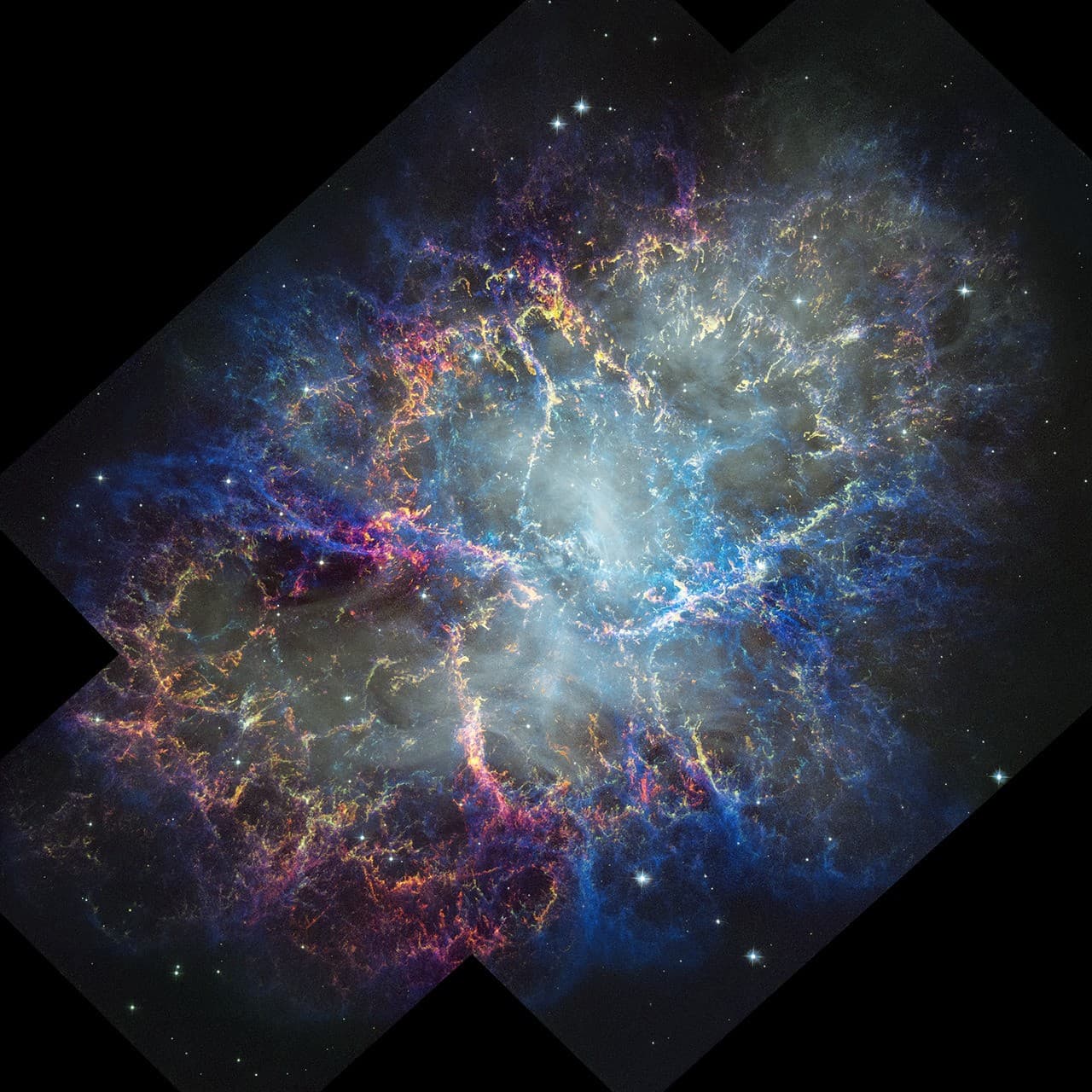
Sometimes the cosmos rewards patience. A quarter-century after Hubble's first full observations of the Crab Nebula, the telescope has returned for a fresh look—and the results are a masterclass in astronomical change detection.
The Setup
The Crab Nebula (Messier 1) is the remnant of supernova SN 1054, witnessed by Chinese astronomers nearly a thousand years ago. Located 6,500 light-years away in Taurus, it's not just any supernova remnant—it's powered from within by a pulsar, a rapidly rotating neutron star that fires synchrotron radiation outward, continuously expanding the nebula at roughly 3.4 million miles per hour.
What Hubble Saw
In 1999, Hubble captured the first detailed wide-field image of the whole nebula using its Wide Field Planetary Camera 2. Now, with 2024 data from the upgraded Wide Field Camera 3, astronomers can directly compare how the nebula has evolved. The result: clear, measurable outward motion of the filamentary structure—something only Hubble's combination of longevity and resolution can reliably detect.
The Technical Detail
What makes this fascinating is how it's expanding. Unlike typical supernovae driven by shockwaves from the initial blast, the Crab's motion is driven by the pulsar wind. The filaments at the periphery have moved more than those near the centre, and critically, they're not stretching—they're simply translating outward.
The high-resolution imagery also reveals 3D structure through shadows cast by filaments onto the synchrotron haze of the nebula's interior. Counterintuitively, some of the brightest filaments cast no shadows, indicating they're located on the far side of the nebula.
The Bigger Picture
The real value lies ahead. Hubble's optical data can now be paired with James Webb Space Telescope's 2024 infrared observations of the same target. A true multiwavelength view of one of astronomy's most dynamic objects—tracked across a quarter-century of change. That's the kind of continuity that separates snapshots from narratives.
The paper, published in The Astrophysical Journal, is authored by William Blair and team at Johns Hopkins University. As Blair notes: "We tend to think of the sky as being unchanging. However, with the longevity of the Hubble Space Telescope, even an object like the Crab Nebula is revealed to be in motion."
For anyone tracking deep-sky objects with a decent scope, the Crab is always worth revisiting. It's dynamic, it's close (cosmically speaking), and now we have proof it's measurably different than it was when many of us were children.
Source: NASA Hubble Press Release | ESA Hubble News
Comments
Loading comments...