Space
Astronomers Spot a Mirror of Our Solar System Forming
Astronomers Spot a Mirror of Our Solar System Forming
There's something profound about witnessing the same process that created your world playing out in real-time, 437 light-years away.
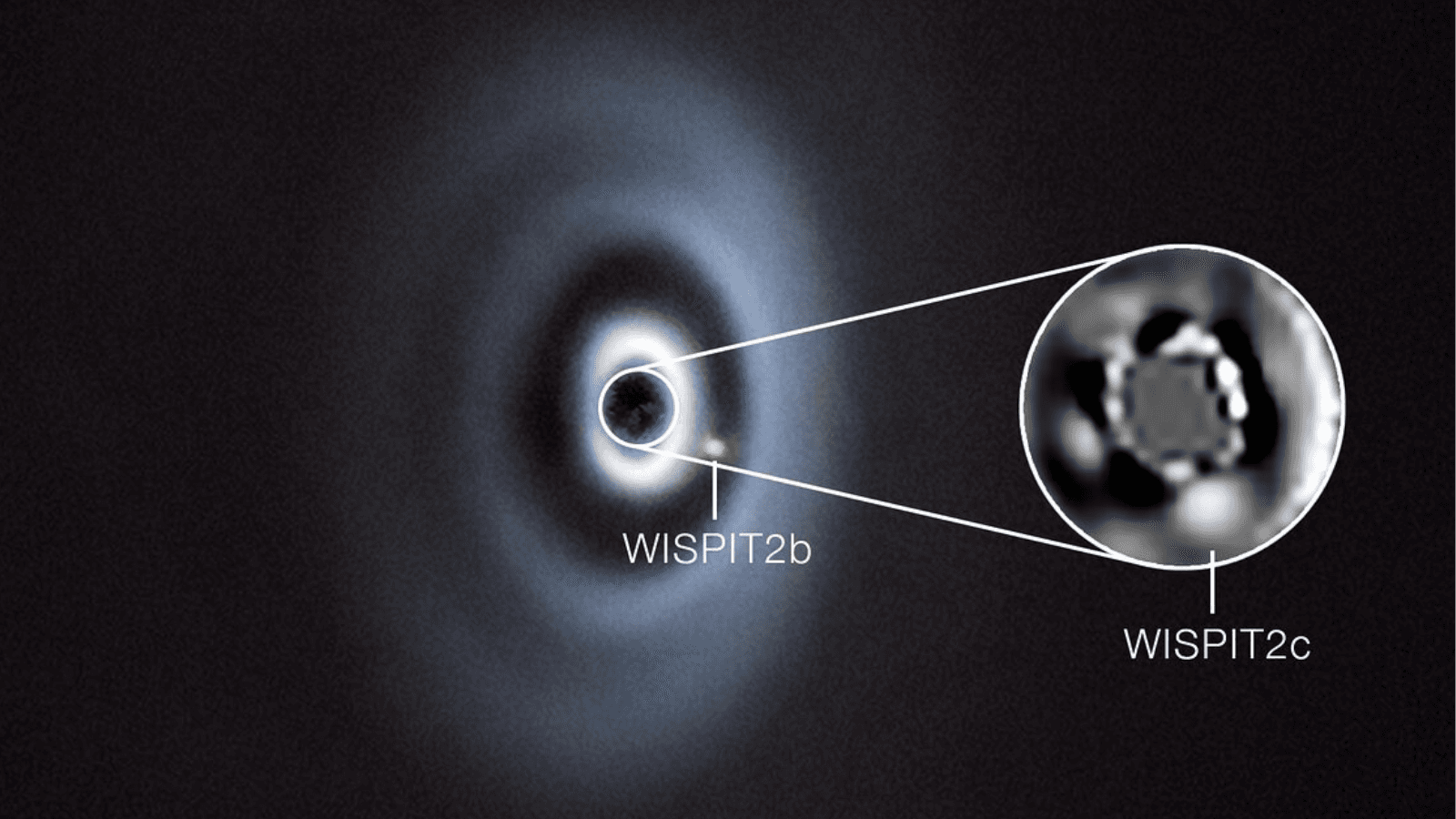
Astronomers have just observed two planets actively forming around the young star WISPIT 2. The significance? The system's architecture—an inner planet and an outer giant—mirrors our own solar system's early structure, circa 4.6 billion years ago. It's a time capsule of planetary genesis.
The Discovery
WISPIT 2b was spotted first: a Jupiter-mass world orbiting at 60 AU from its star (60 times Earth's distance from the Sun). Following that detection, astronomers found WISPIT 2c, a closer planet at roughly 15 AU, about four times nearer to the star than WISPIT 2b. Both are actively carving grooves in the protoplanetary disk—visible gaps and bands that reveal their gravitational influence shaping the nebula that birthed them.
The star itself is just 5.4 million years old. To put that in perspective, it's an infant in cosmic terms. And yet, it already boasts a multi-planet system in the middle of formation.
Why This Matters
This is only the second system where astronomers have successfully imaged two forming planets simultaneously. The first, PDS 70, lacks the extended disk and distinct structure that WISPIT 2 displays. That means WISPIT 2 offers an unparalleled laboratory for studying planetary system architecture as it happens.
Christian Ginski, University of Galway: "WISPIT 2 gives us a critical laboratory not just to observe the formation of a single planet but an entire planetary system."
The team used the Very Large Telescope (VLT) and its interferometer (VLTI) in Chile, along with the SPHERE and GRAVITY+ instruments for direct imaging and confirmation. The newest upgrade to GRAVITY+ was critical—without it, the inner planet would have been lost in the glare of its young star.
What's Next
There are hints of a third, less-pronounced gap farther out—potentially a Saturn-mass world. If confirmed via the upcoming Extremely Large Telescope (ELT, currently under construction in the Atacama Desert), the full WISPIT 2 system would resemble a mini-version of our own solar system's inner architecture.
Casper Lawlor, lead author: "We suspect there may be a third planet carving out this gap, potentially of Saturn's mass, owing to the gap's being much narrower and shallower."
This is the kind of discovery that reminds you why we invest in ever-larger telescopes. Not to answer abstract questions, but to literally witness the birth of worlds.
Source: Space.com Article | The Astrophysical Journal Letters
Comments
Loading comments...