JWST Discovers Early Galaxy That Challenges Our Understanding of Galaxy Formation
JWST Discovers Early Galaxy That Challenges Our Understanding of Galaxy Formation
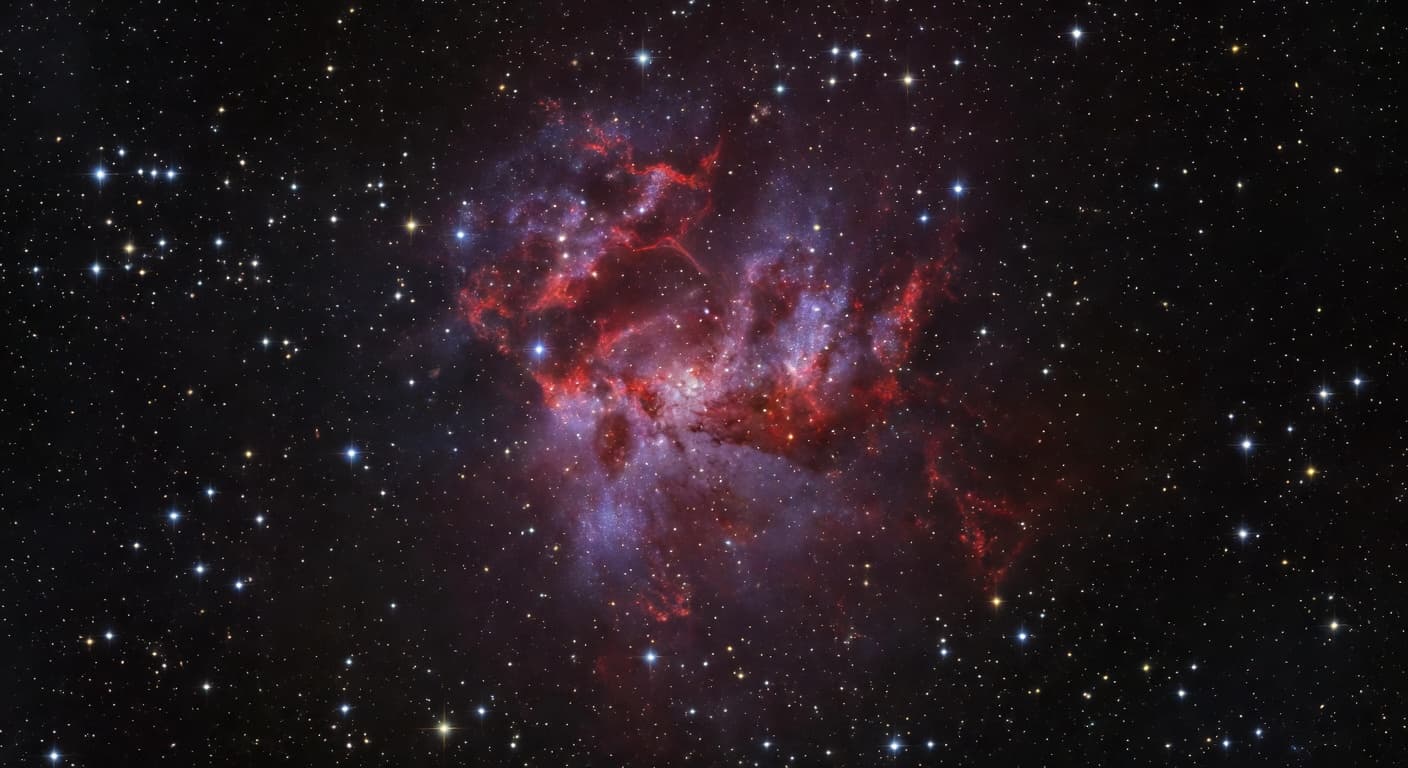
The James Webb Space Telescope has made another remarkable discovery that's causing astrophysicists to reconsider fundamental models of galaxy formation. On May 4, 2026, astronomers announced the discovery of a non-rotating galaxy from the early universe—an observation that shouldn't be possible according to our current understanding of physics.
The Paradox: A Galaxy Without Spin
Nearly all galaxies rotate. When massive objects form from the collapse of rotating clouds of gas and dust, conservation of angular momentum dictates that they must spin. It's the same principle that causes a spinning ice skater to move faster as they pull in their arms. Galaxies should spin. But this early-universe galaxy, spotted as part of the JWST COSMOS-Web survey, is stubbornly stationary.
The discovery comes from the detailed spectroscopic analysis of the galaxy, which revealed that its constituent stars are not moving in the rotational patterns we'd expect. This is genuinely puzzling to the astronomical community, and it raises serious questions about what we thought we understood about galaxy formation in the young universe.
What This Means for Galaxy Formation Theory
Current models of galaxy formation rely on hierarchical structure—smaller galaxies merge to form larger ones, and the merger process imparts angular momentum through the chaotic gravitational interactions of the colliding systems. Over time, galaxies settle into rotating disks or oblate spheroids, their shapes determined by their spin.
But a non-rotating galaxy in the early universe suggests something unexpected was happening in the first billion years of cosmic history. Possibilities include:
- Different merger dynamics: Perhaps early mergers occurred in configurations that cancelled out angular momentum rather than adding to it
- Novel formation mechanisms: We might be missing an entire category of galaxy formation process that occurred only in the early universe
- Modified physics: While unlikely, it's theoretically possible that the extreme conditions of the early universe produced effects not captured by our current models
The JWST Advantage
This discovery exemplifies JWST's revolutionary capability. Previous telescopes like Hubble could identify distant galaxies, but JWST's infrared sensitivity and spectroscopic resolution allow astronomers to determine the physical properties and dynamics of galaxies we couldn't fully characterize before. We're not just seeing farther back in time—we're seeing with unprecedented detail.
The COSMOS-Web survey itself is ambitious: it's mapping 1 million galaxies across 0.6 square degrees of sky with exquisite detail. Among that vast population, this non-rotating outlier stands out, demanding explanation.
Why This Matters
Fundamentally, this discovery reminds us that the universe is stranger and more complex than our models predict. Galaxy formation remains one of the major outstanding questions in cosmology. Each JWST observation adds data points that constrain and refine our theories.
For researchers working on simulations of cosmic structure formation, this observation is a wake-up call. Future simulations will need to account for formation pathways that produce non-rotating systems, or we'll fail to match the diversity of galaxies we observe in the early universe.
The mystery of the non-rotating galaxy is exactly the kind of observation that drives science forward—a challenge to established thinking that demands investigation and innovation.
Comments
Loading comments...