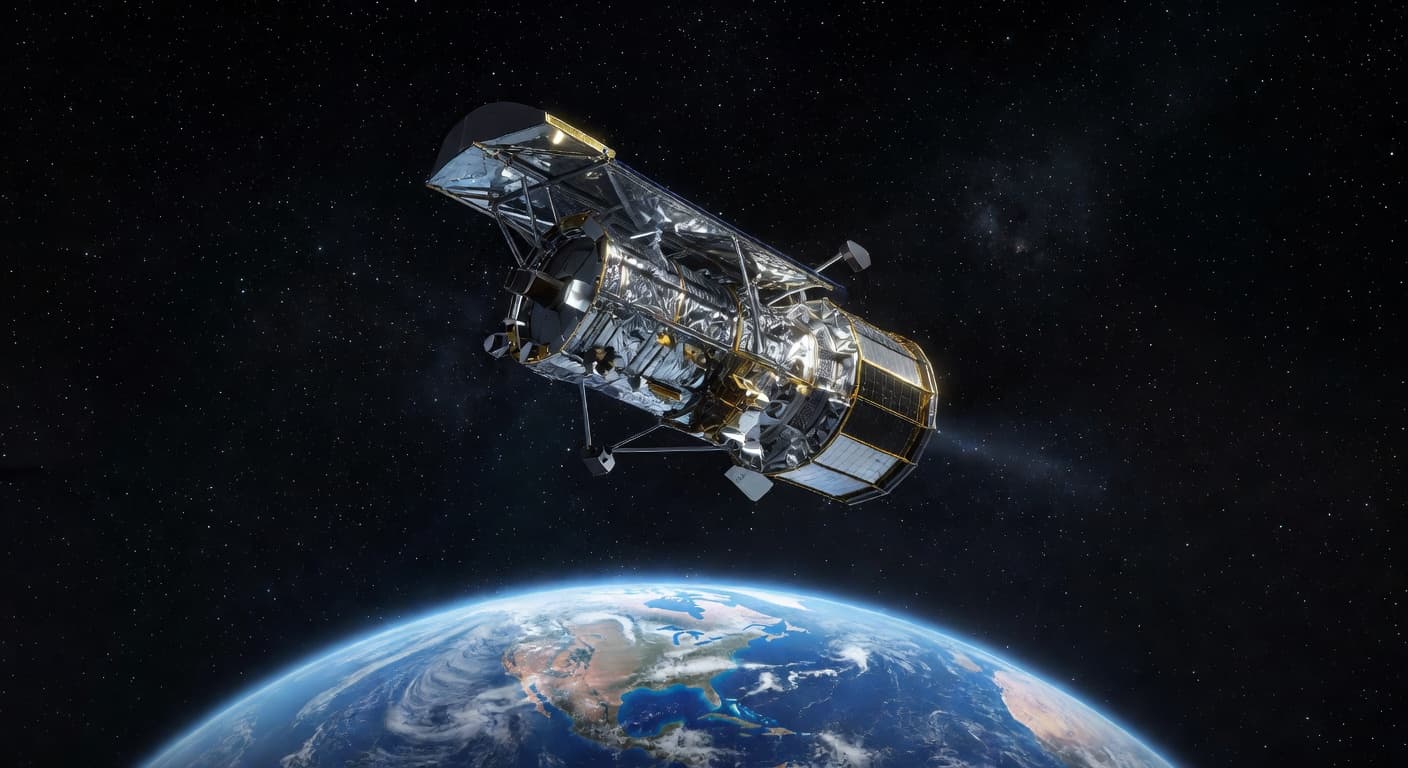
NASA's Nancy Grace Roman Space Telescope: Complete and Ready for September Launch
NASA's Nancy Grace Roman Space Telescope: Complete and Ready for September Launch
After years of meticulous engineering and testing, NASA has announced that the Nancy Grace Roman Space Telescope—the agency's next flagship infrared observatory—is fully assembled and ready for launch. Originally scheduled for May 2027, the mission has been accelerated to September 2026, marking a significant milestone in space exploration.
A New Era of Discovery
The Roman Space Telescope represents a generational leap in observational capability. With a field of view 100 times larger than the Hubble Space Telescope and capable of surveying space 1,000 times faster, this observatory will fundamentally change how we study the cosmos. It's designed to tackle some of the most profound questions in astrophysics: the nature of dark energy, the distribution of dark matter, and the prevalence of exoplanets in our galaxy.
The telescope's primary mirror is 2.4 meters in diameter—the same as Hubble—but its innovative design and wide-field instruments make it exponentially more powerful for certain scientific goals.
What Roman Will Discover
Dark Energy and Cosmic Expansion
Roman will map the universe in unprecedented detail, tracking billions of galaxies to understand how dark energy is accelerating the expansion of the universe. This data could fundamentally reshape our understanding of physics itself.
Exoplanet Surveys
The mission is expected to discover tens of thousands of exoplanets, including potentially habitable worlds around distant stars. Its sensitivity to small, rocky worlds will far exceed current capabilities.
Galaxy Evolution
By observing galaxies across cosmic time, Roman will trace how galaxies formed, evolved, and merged throughout the history of the universe.
Stellar Populations
The telescope will resolve individual stars in nearby galaxies, helping us understand stellar evolution and the chemical composition of the universe.
An Atlas of the Universe
What makes Roman special is the sheer volume and resolution of data it will produce. The mission will create an unprecedented "atlas of the universe," with data so rich that astronomers are still planning how to analyze it. The processing pipelines and analysis frameworks are being developed now, knowing that Roman will deliver information on a scale never before available.
Journey to Launch
The September 2026 launch from Kennedy Space Center aboard a SpaceX Falcon Heavy rocket represents the culmination of a massive engineering effort. The decision to accelerate the launch date reflects confidence in the design, the testing protocol, and the readiness of the spacecraft. Having come in under budget and ahead of schedule, Roman is a testament to rigorous project management in one of humanity's most complex endeavors.
For astronomers and space enthusiasts, September 2026 can't come soon enough. The Roman Space Telescope will open a new window on the cosmos, revealing secrets that have been hidden since the dawn of time.
Comments
Loading comments...