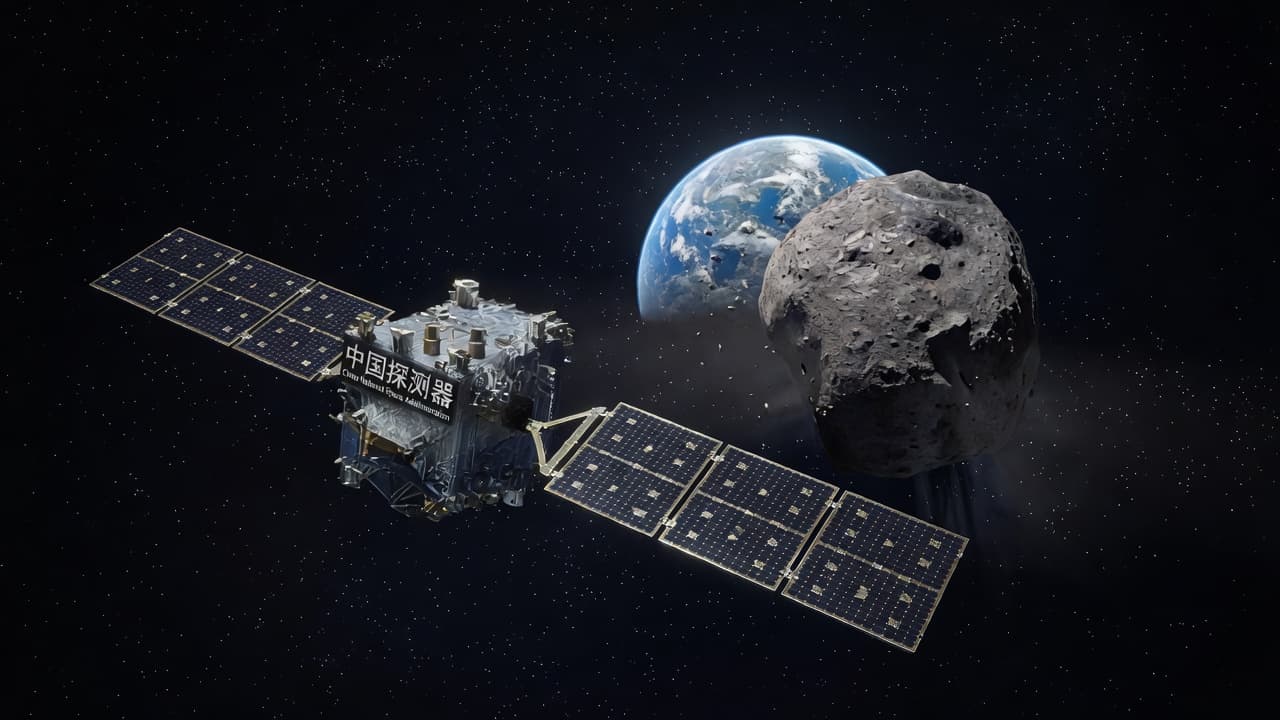
China's Tianwen-2 Reaches Asteroid 469219 Kamoʻoalewa
China's Tianwen-2 Reaches Asteroid 469219 Kamoʻoalewa
China's Tianwen-2 spacecraft is approaching its target this week—a small near-Earth asteroid that occasionally gets called Earth's "mini-moon." The spacecraft is scheduled to arrive at 469219 Kamoʻoalewa around July 4, 2026, making this one of the most significant asteroid missions of the year.
What Makes Kamoʻoalewa Interesting?
Kamoʻoalewa is a quasi-satellite of Earth—it orbits the sun but stays in Earth's gravitational neighborhood, sometimes looping closer to us than the moon. The name comes from Hawaiian mythology: Kamoʻoalewa (meaning "the one that wobbles") is how ancient Hawaiians described celestial objects that seemed to dance across the sky.
This is exactly the kind of target that makes for compelling science: accessible from Earth, ancient composition, and likely rich with material that could tell us about planetary formation and the early solar system.
The Mission
Tianwen-2 will:
- Observe and map the asteroid's surface in detail during its close approach
- Collect samples using robotic arms and collection mechanisms
- Return samples to Earth in 2027, becoming China's first asteroid sample-return mission
- Continue onward to rendezvous with a main-belt comet after Earth return
This multi-target approach is ambitious. Most sample-return missions (like Japan's Hayabusa2 or NASA's OSIRIS-REx) visit a single target. Tianwen-2's extended mission showcases China's growing confidence in deep-space operations.
What It Means for Space Science
The timing is excellent for the international community. We'll soon have samples from Kamoʻoalewa alongside ongoing sample analysis from other near-Earth asteroids. Combined with James Webb and other observations, these materials will let scientists refine models of asteroid composition, space weathering, and the chemical diversity of near-Earth objects.
For asteroid enthusiasts and astrophotographers, this is a reminder that these small worlds aren't just scientific abstractions—they're visible, reachable, and increasingly part of humanity's exploration agenda.
Source: NASA Space Exploration Updates and Space.com 2026 spaceflight calendar
Comments
Loading comments...